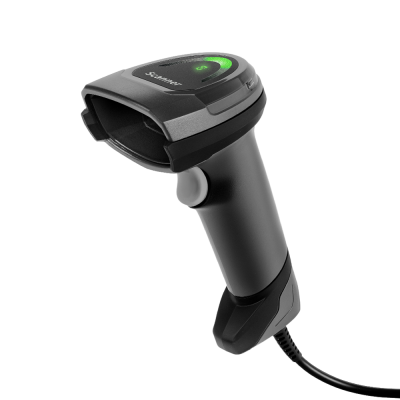
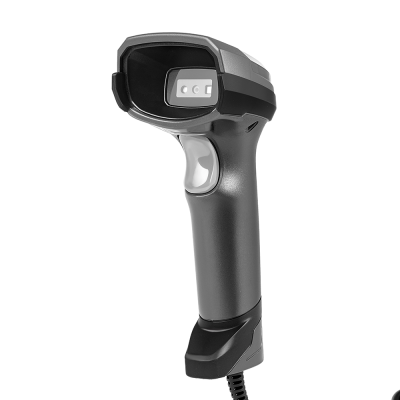
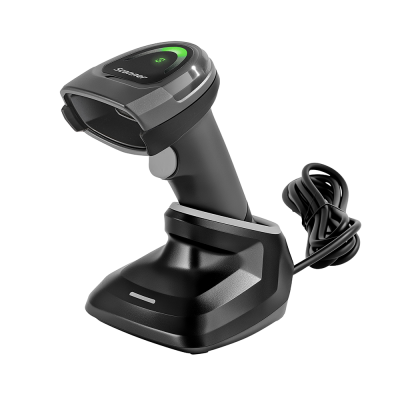
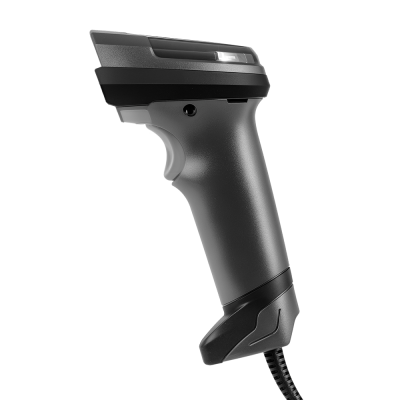
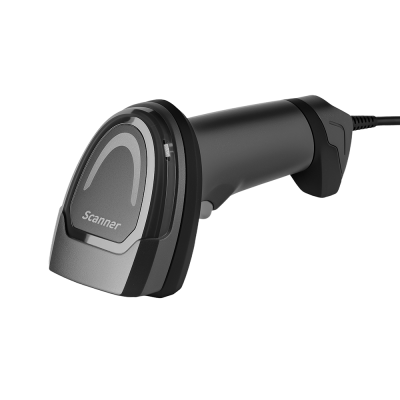
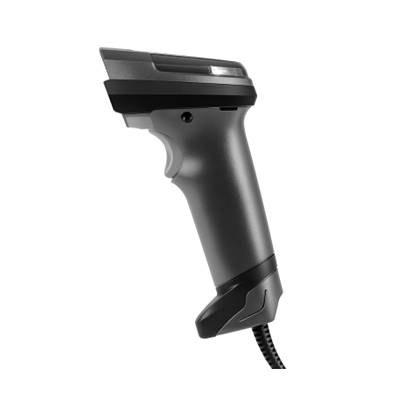
SN-HS28 2D Wired Barcode Scanner
Retail hardware specified for the work it actually does.
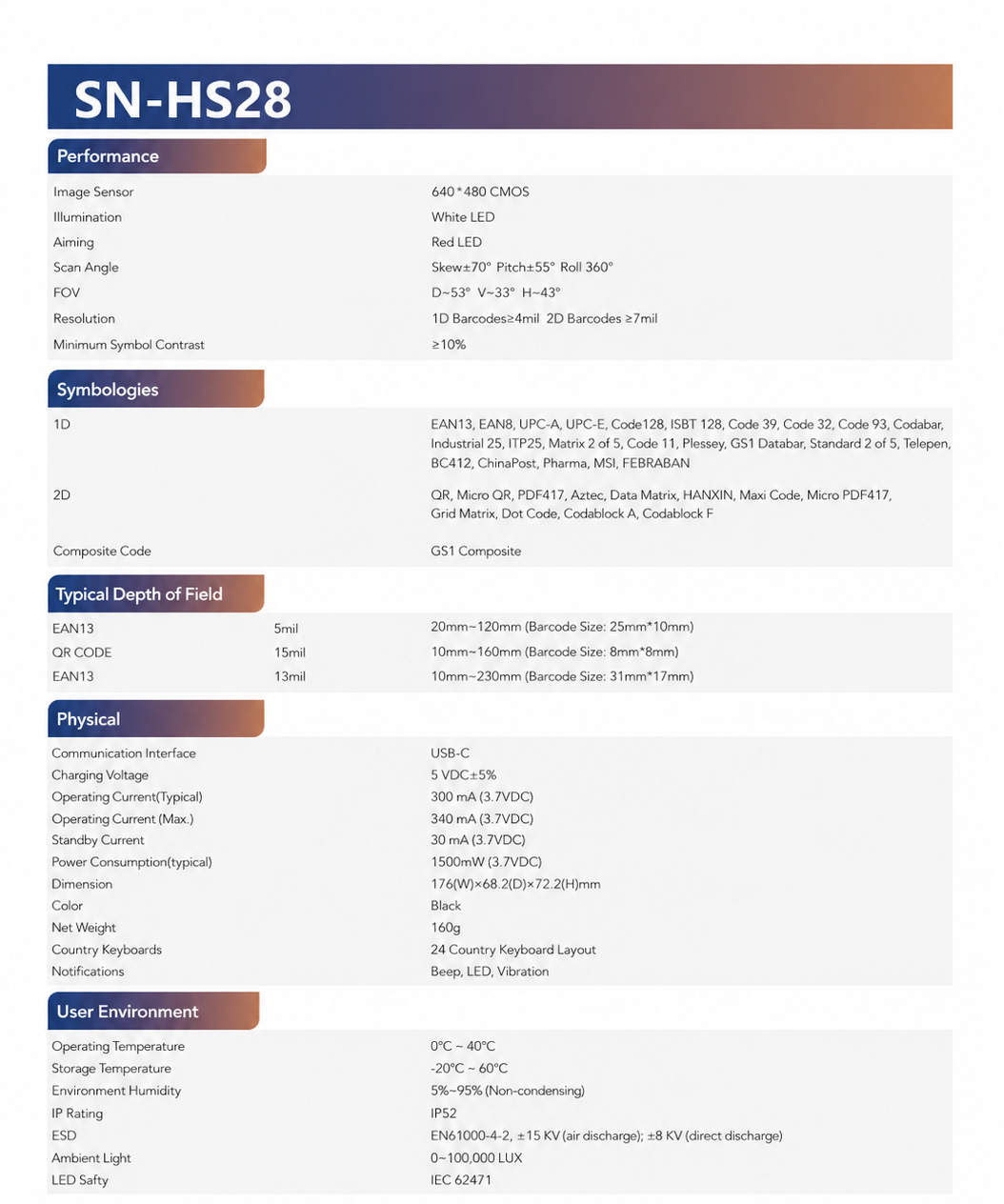
24 national keyboard layouts in firmware, a USB-C port instead of a captive cable, and a 10% minimum symbol contrast that keeps faded thermal labels readable. A 13 mil retail label reads out to 230 mm — the longest reach in this range.
- MOQ 1 with 10–15 day lead time on stock models
- Spec sheets and SDK released before the order
- 12-month warranty, OEM branding available on volume orders
- SKU
- SQN-SN-HS28-2D-W
- Availability
- In Stock
- Lead Time
- 10-15 business days
- Warranty
- 12 months standard
The SN-HS28 is the model to specify when the same reader has to work in more than one country. It carries 24 national keyboard layouts in firmware, so a unit shipped to a German site types QWERTZ and a unit shipped to a French site types AZERTY without different hardware or a reflash. For a distributor stocking one SKU across a region, that removes the part-number split entirely.
The connection is USB-C rather than a captive cable. That is a small change with a large operational consequence: a damaged cable is a 2 euro part and a five-second swap, not a reader sent back for repair. It also means the same port can be fed from a terminal, a hub or a powered dock.
The imaging engine is a 640 × 480 CMOS sensor with an independent red aiming LED. The 2D resolution floor is 7 mil rather than the usual 4–5 mil, which is the honest limitation of this model and the reason its depth of field reaches further than its siblings: a larger element is resolvable at a greater distance, so a 13 mil retail label reads out to 230 mm.
Core specifications
| Imager | CMOS, 640 × 480 pixels |
|---|---|
| Illumination | White LED |
| Aiming | Red LED |
| Field of view | 53° diagonal, 43° horizontal, 33° vertical |
| Scan angle | Skew ±70°, pitch ±55°, roll 360° |
| Resolution | 1D ≥ 4 mil; 2D ≥ 7 mil |
| Minimum symbol contrast | ≥ 10% |
That 10% minimum contrast is the standout figure. Most readers in this class need 20–25%. A 10% floor means faded thermal labels, low-toner laser prints and codes on colored stock still decode — which is exactly the condition of a label that has been on a shelf for two years.
Decode range
| EAN-13, 5 mil | 20–120 mm (label 25 × 10 mm) |
|---|---|
| QR Code, 15 mil | 10–160 mm (label 8 × 8 mm) |
| EAN-13, 13 mil | 10–230 mm (label 31 × 17 mm) |
230 mm is the longest reach of any reader in this range. It is still a near-field device — it will not read a pallet label from a forklift — but it covers the full height of a checkout counter without the operator leaning in.
Symbologies
1D: EAN-13, EAN-8, UPC-A, UPC-E, Code 128, ISBN, Code 39, Code 32, Code 93, Codabar, Industrial 2 of 5, ITF-25, Matrix 2 of 5, Code 11, Plessey, GS1 DataBar, Standard 2 of 5, Telepen, BC412, China Post, Pharmacode, MSI, FEBRARIAN.
2D: QR Code, Micro QR, PDF417, Micro PDF417, Aztec, Data Matrix, Han Xin, MaxiCode, Grid Matrix, DotCode, Codablock A, Codablock F.
Composite: GS1 Composite.
Han Xin and Grid Matrix are Chinese and industrial symbologies that rarely appear on a non-Chinese specification sheet. GS1 Composite matters in pharma and in logistics, where a linear code and a 2D component are printed as a single symbol to carry both the GTIN and the batch data. If your customer's labels are GS1 Composite, confirm it before ordering — a reader that decodes only the linear part will pass the GTIN and silently lose the batch.
Feedback in a noisy store
Three independent confirmation channels: a beeper, a tri-color LED, and a vibration motor. The vibration is the one that gets used. In a store with music, tills and a queue, the beep is inaudible; in a quiet pharmacy at night, the beep is unwelcome. Vibration confirms the read either way, and it can be configured to run alone.
Physical and power
| Dimensions | 176 × 68 × 72 mm (W × D × H) |
|---|---|
| Net weight | 160 g |
| Color | Black |
| Interface | USB-C, wired |
| Input voltage | 5 VDC ±5% |
| Operating current | 300 mA typical, 340 mA maximum (quoted at 3.7 VDC on the manufacturer's sheet) |
| Standby current | 30 mA |
| Power consumption | 1,500 mW typical |
| Keyboard layouts | 24 national layouts in firmware |
The current figures are quoted at 3.7 VDC because the manufacturer measures the platform that way. On a 5 V USB-C host the wattage is what matters, and at 1.5 W it sits comfortably inside a standard port's budget even with a hub in between.
Environment
| Operating temperature | 0 °C to +40 °C |
|---|---|
| Storage temperature | −20 °C to +60 °C |
| Humidity | 5% to 95%, non-condensing |
| Ingress protection | IP52 |
| ESD | EN 61000-4-2, ±15 kV air discharge, ±8 kV direct discharge |
| Ambient light | 0–100,000 lux |
| LED safety | IEC 62471 |
The 0–40 °C operating window is the tightest in this range and it is worth being explicit about. This reader is specified for indoor retail, not for a cold store, a loading bay in winter, or an unshaded vehicle. If the deployment includes those conditions, choose a model with a −20 °C floor instead. The ±15 kV air-discharge ESD rating, by contrast, is generous — it survives the static from a shopping trolley in a dry winter store.
Where it fits
- Multi-country rollouts. One SKU, 24 keyboard layouts, no per-market part numbers.
- Supermarkets with faded shelf labels. The 10% contrast floor is the reason this model gets picked for a store that has never been relabelled.
- Pharmacy and logistics. GS1 Composite support keeps the batch data attached to the GTIN.
- Noisy or silent environments. Vibration feedback works where a beeper does not.
- Field service and rental fleets. USB-C means a broken cable does not take a unit out of service.
Limits
Wired only, USB-C. The 2D resolution floor is 7 mil, so very small Data Matrix stamps are outside its capability — a 4 mil reader is the right choice there. And the 0–40 °C window rules out unheated spaces.
Ordering
SKU SN-HS28. USB-C cable included. Keyboard layout is set by configuration barcode at the factory or in the field. MOQ 1, 10–15 days on standard configuration, OEM branding from 50 units.
Product images
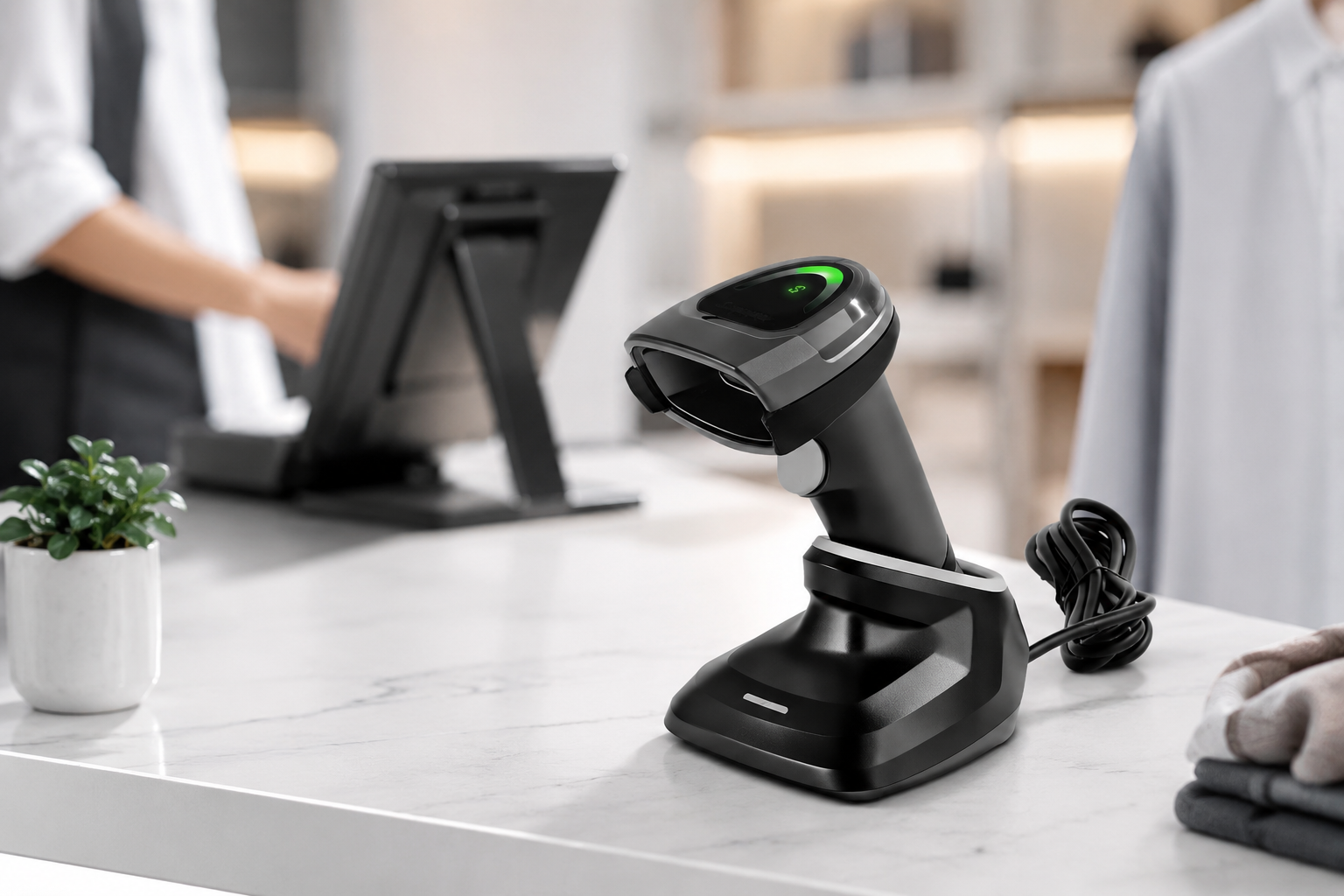
24 national keyboard layouts in firmware — one SKU for a whole region
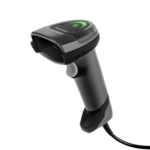
Twenty-four national layouts live in firmware, so a unit moves between markets by configuration barcode from the manual instead of being returned or re-ordered under a different part number. That is the whole reason to carry the layouts on the device rather than in the SKU. The body is 160 g at 176 × 68 × 72 mm, sealed to IP52, with ESD rated ±15 kV air and ±8 kV direct and LED safety to IEC 62471.
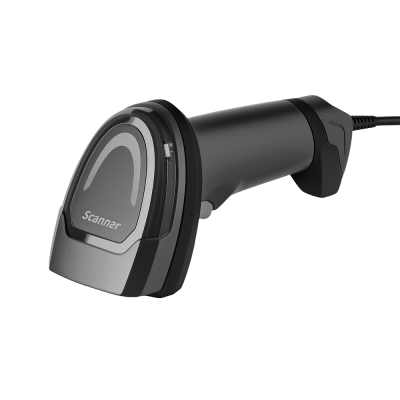
USB-C instead of a captive cable: a damaged cable is a five-second swap
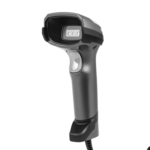
The cable is a USB-C connection rather than a captive lead, so a damaged cable is a five-second swap instead of an RMA — the failure that actually ends the life of a sealed handheld. It presents as a USB keyboard, which means an Android tablet or phone in host mode receives keystrokes; iOS needs the right adapter and app support, so test before committing. There is no RS232 variant: if the host is a legacy terminal, this is not the model.
≥ 10% symbol contrast and a 230 mm reach on 13 mil labels
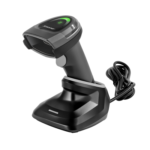
A 10% symbol contrast floor is a sensitivity figure: the bars need only a tenth of full-scale difference from the spaces for the decoder to separate them. Reach is 230 mm on a 13 mil label, so the code does not have to be brought to the window. Resolution splits by symbology — 4 mil for 1D and 7 mil for 2D, because a 2D module is smaller than a bar for the same label area. The operating window starts at 0 °C, so it is not a cold-store unit.
Technical Details
Full specifications, documentation, and customization options for engineering evaluation.
| Dimensions | 176 × 68 × 72 mm (W × D × H) |
|---|---|
| Barcode Scanner | 1D, 2D and composite, 640 × 480 CMOS; 1D ≥ 4 mil, 2D ≥ 7 mil; QR, Micro QR, PDF417, Micro PDF417, Aztec, Data Matrix, Han Xin, MaxiCode, Grid Matrix, DotCode, Codablock A/F, GS1 Composite |
| Power Supply | 5 VDC ±5% over USB-C; 300 mA typical, 340 mA maximum, 30 mA standby; 1,500 mW typical consumption |
| Environment | Operating 0 °C to +40 °C; storage −20 °C to +60 °C; 5–95% RH non-condensing; IP52; ESD EN 61000-4-2 ±15 kV air / ±8 kV direct; 0–100,000 lux; LED safety IEC 62471 |
Frequently Asked Questions
Common inquiries from retailers, system integrators, and procurement teams.
Can the keyboard layout be changed after delivery?
Yes. It is set by configuration barcode from the manual, so a unit can be moved between markets without being returned. That is the point of carrying 24 layouts in firmware rather than in a part number.
Why 7 mil for 2D and 4 mil for 1D?
Two-dimensional codes pack more information into the same area, so each module is smaller for a given label size. The sensor resolves a 4 mil bar easily but needs 7 mil before a 2D module is reliable. This is a property of the symbology, not a defect.
Does USB-C mean it works with a phone or tablet?
It presents as a USB keyboard, so an Android tablet or phone with host mode will receive keystrokes. iOS devices need the correct adapter and app support — test before committing.
Is it suitable for a cold store?
No. The operating window starts at 0 °C. Condensation on the window below that temperature will stop reads before the electronics are affected, and the specification does not cover it.
Request a Quote for
SN-HS28 2D Wired Barcode Scanner
Our engineering team comes back with volume pricing, OEM options and lead time within one business day.
- Response within 24 hours
- NDA available for enterprise projects
- Free developer sample for qualified integrators
Synchronize Your Retail Ecosystem
Pair this terminal with dedicated peripherals for a fully integrated, single-vendor smart store deployment.