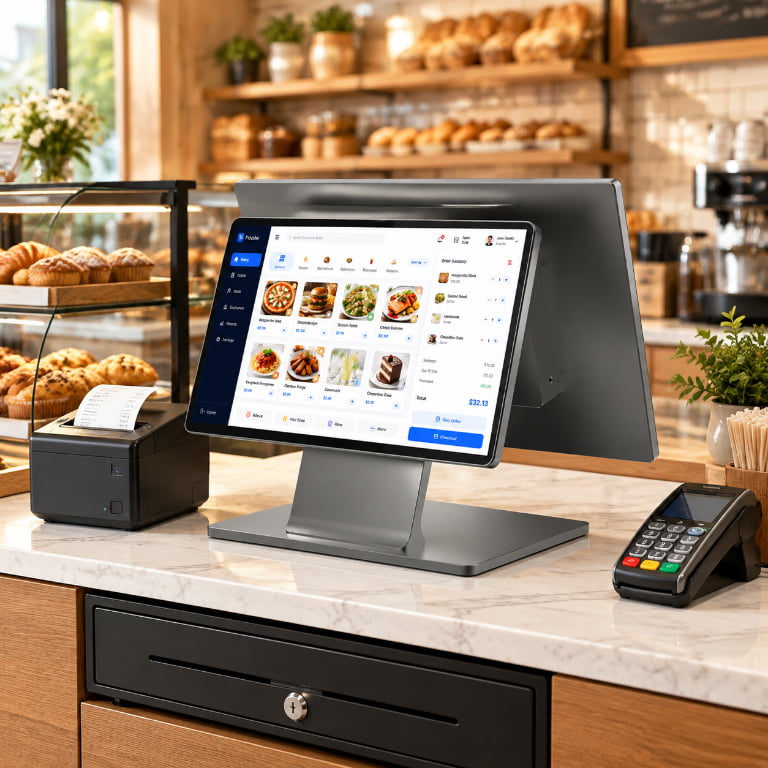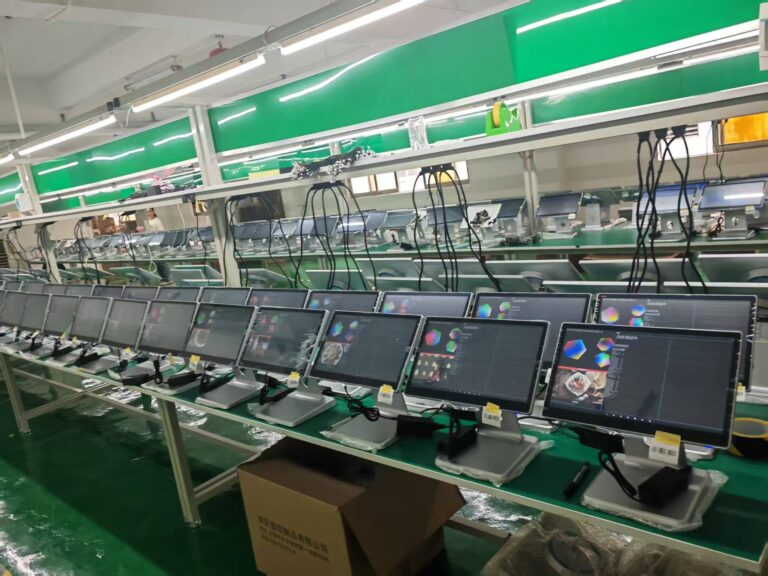
Three suppliers quote for what the buyer believes is the same terminal, and the three numbers come back twelve percent apart. The instinct is to read that spread as margin, or as one supplier being expensive. It is almost never either. It is six lines attached differently: the cords, the carton, the certificate, the day the warranty clock starts, the freight, and the way spare parts are counted.
This page is about the arithmetic of comparison rather than the art of negotiation. It sets out what to normalize, the two lines you can calculate yourself with nothing but a datasheet, and a worksheet you can fill in during the meeting where the bids get opened. The document that produces comparable bids is a separate job, covered in the POS hardware RFQ template; this page assumes the replies are already on the table.
Why the same model comes back at different prices
A quotation is not a price for a product. It is a price for a scope, written by someone who filled the gaps in your enquiry with assumptions. Where your enquiry was specific, the assumptions disappear and the numbers converge. Where it was silent, each supplier assumes the arrangement that is cheapest to quote, and the differences accumulate without anyone intending to mislead.
Three of those assumptions are invisible in the unit price and one of them is invisible in the total:
- What is inside the box. A terminal needs a power adapter, a cord for the destination market, and often a drawer lead and a USB cable. If the enquiry did not name them, a quote may price the unit alone.
- What happens after delivery. Who pays for a variant certification test, who owns the test report, and when the warranty clock starts are all scope decisions that show up as cost months later.
- What the number means. Free on board, cost and freight, and delivered duty paid are three different commercial positions. The same goods priced at the same margin produce three different numbers.
None of this requires a supplier to be sharp. It requires only that two people read the same silent enquiry and filled the silence differently.
The number to compare is landed cost per working unit
One figure makes the bids comparable, and it is not the unit price. It is what one installed, warranted, spares-covered unit costs you at your own door:
Landed cost per working unit = (goods + packaging + certification share + freight + insurance + duty) divided by delivered units, plus spare parts per unit, plus the expected cost of in-warranty failures.
Two of those terms are easy to forget. The certification share is a fixed cost per model per market, so it divides by volume: on a two-hundred-unit order it is a small number per unit, and on a ten-unit order it can be one of the largest lines in the quote. The expected failure cost is the one buyers never write down, and it is why the spare parts allowance and the warranty definition belong in the same comparison as the price.
Everything else on this page is about filling those terms in from documents you already have.
Six lines that move the total
These are the lines where two quotations for the same hardware stop being comparable. For each one, the question to ask and the way to neutralize it.
| Line | How it hides in a quotation | What to ask | How to neutralize it |
|---|---|---|---|
| 1. BOM completeness | Unit price only; adapter, cord, drawer lead and USB cables priced separately or omitted | "List every item in the carton, by part, with the cord type for our market" | Add the missing items to the cheaper bid at the same supplier's own line prices, then compare |
| 2. Packaging | Gift box quoted, export carton and palletizing treated as extra | "Is the export carton in the unit price, and what is the carton quantity and gross weight" | Bring both bids to export carton standard; you cannot ship a gift box |
| 3. Certification | "CE and FCC available" with no statement of whose name is on the report | "Is the report in your name or ours, and who pays if our branding needs a variant test" | Treat a variant test as a fixed cost, divide by order quantity, add to the bid that needs it |
| 4. Warranty start | Term stated without a start event | "Does the term run from shipment, arrival, installation or first power-on" | Recalculate every bid to months of cover after installation |
| 5. Freight and insurance | One number with the Incoterm in small print, or the freight folded into the unit price | "Quote goods, freight and insurance as three separate lines, FOB and CIF" | Convert to one delivery point; see the calculation below |
| 6. Spare parts | A percentage with no basis stated | "Two percent of what, shipped when, and which parts" | Convert to whole units per hundred and compare like with like |
Work down the table in this order. The first two lines change the goods, the third changes a fixed cost, and the last three change what you own after the invoice is paid. Comparing a bid that has been normalized on lines one and two against one that has not is the single most common way a purchasing decision goes wrong.
Line one is worth checking against the model rather than the bid, because what a carton has to contain differs between a terminal with a built-in printer and one without. The all-in-one POS terminal range lists the interfaces and the power input model by model, which is enough to tell whether an adapter is genuinely needed or whether the bid is describing a unit that requires a second purchase.
Freight: the line you can compute yourself
Freight is the term buyers most often accept as a black box, and it is the one that needs no rate card to normalize. You need the chargeable quantity, and a datasheet usually carries it.
Take an 80 mm receipt printer from this range. The published packing data is a carton of 48 x 45.1 x 35.2 cm, 19 kg gross, eight units per carton. Run the arithmetic on a two-hundred-unit order:
| Step | Calculation | Result |
|---|---|---|
| Carton volume | 48 x 45.1 x 35.2 cm | 76,201 cm³ = 0.0762 m³ |
| Volume per unit | 0.0762 m³ divided by 8 | 0.0095 m³ |
| Cartons for 200 units | 200 divided by 8 | 25 cartons |
| Total volume shipped | 25 x 0.0762 m³ | 1.905 m³ |
| Total gross weight | 25 x 19 kg | 475 kg |
| Air chargeable basis | 76,201 cm³ divided by 6,000 | 12.7 kg per carton, below the 19 kg actual, so actual weight governs |
That is the whole normalization. With 1.905 cubic meters and 475 kilograms you can price the movement yourself against any forwarder's quotation, and you can see immediately what a delivered price has buried inside it. If one supplier quotes free on board and another quotes delivered, the difference between the two numbers should be close to your own freight figure. Where it is not, the gap is either the freight margin or an insurance premium, and both are worth naming as separate lines.
The same arithmetic tells you why carton design is a commercial decision and not a factory detail. The same arithmetic is why paper width is a logistics question as well as a receipt question, as 58 mm against 80 mm thermal printers sets out. A carton that fits two more units per layer reduces the cubic meters on every shipment you ever make, and that saving compounds across a rollout in a way that a small discount on the unit price does not.
Warranty: the clock starts before the box is opened
A warranty term with no start event is not a term, it is a number. The four definitions in common use start the clock at shipment, at arrival, at installation or at first power-on, and on a staged rollout the difference between the first and the last is measured in months of cover you paid for and never used.
Put it on a timeline. Five hundred units delivered across six months, with the first batch arriving in March and the last site going live in September. Under a term counted from shipment, the March batch sits in a warehouse for five months before anyone switches it on, so a fifth of a twelve-month term expires unused. Under a term counted from installation, the same units have their full twelve months from the day the lane opens.
There is a second effect that costs more, and it is the one that appears in the second year. Our terminal lines carry 24-month service coverage: twelve months of warranty, then repair at parts cost through month 24 with labor included. On that structure, three months in a warehouse is roughly an eighth of the total coverage gone before the unit has printed a receipt. Extended warranty contracts of three or five years are available where the rollout needs the coverage to outlast the deployment.
Normalize every bid to months of cover after installation. Where a supplier will not move the start event, the honest comparison is to subtract the average storage time from the term you are being offered, and to see whether the price still looks like the best of the three.
Spare parts: two percentages that are not the same number
Spare parts allowances are quoted on two different bases, and they are not interchangeable. One is a percentage of the units ordered; the other is a percentage of the order value. On the same order those two phrases can describe very different quantities of usable hardware. At pilot scale the percentage collapses entirely, and what a spare allowance actually means at twenty units is the arithmetic worth doing before a trial is sized.
The conversion is straightforward. A count-based allowance of two percent on a two-hundred-unit order is four units, shipped with the order in the same carton, available in the back room on the day a lane fails. A value-based allowance of three percent on the same order is a credit against a parts list, and what it buys depends entirely on the prices in that list and on whether whole units or components are counted.
Three questions settle it, and all three belong in the comparison sheet rather than in the contract:
- Per hundred units, how many whole units does the allowance buy? Convert before comparing. Four spare terminals per hundred is a number a store manager can plan around; a percentage of value is not.
- Does it ship with the order or after a claim? Spares in the same carton arrive before the failure. Spares ordered after a claim arrive after the downtime.
- Which parts are in scope? A mainboard and a screen are the expensive parts and the ones worth covering. Consumables are not spares.
Our shipments carry a two percent allowance by unit count, in the same carton. Written that way it is comparable with any other bid; written as a percentage without a basis, it is not, and neither is the competitor's.
Certification: whose name is on the report
The phrase "CE and FCC available" is a statement about capability, not about documents you can use. The question underneath it is who owns the test report and whether your brand can ship on it.
For a buyer ordering under their own brand, this is a scope item with a fixed cost attached, and it is invisible in a unit price. Three things to establish:
- Name on the report. A report issued to the factory covers goods the factory ships under its own name. Shipping under yours may require a variant test, and the answer depends on what changed: a logo etched on the housing is a different case from a different mainboard.
- Market coverage by model. Certification is per product and per market, not a property of a range. A supplier who says the whole line is certified has answered a different question from the one you asked.
- Who pays for the variant. Either way it is a real cost. The only mistake is leaving it out of the comparison and discovering it after the order is placed, when it is no longer a comparison at all.
Ask for the certificate list per model per target market, in writing, with the report references. A supplier who has the documents produces them quickly; one who has the capability says the certification is available, which is a different sentence. Where the order is large enough to justify it, a factory audit answers the same question from the other direction: the factory page lists the process and the inspection standard we work to, which is the context a certification claim sits inside.
A worksheet you can fill in during the meeting
Three bids, six lines, one column that matters. Print this or copy it into the document you will actually keep.
| Line | Supplier A | Supplier B | Supplier C | Normalized to |
|---|---|---|---|---|
| Goods, per unit | Same scope | |||
| Items in the carton | Adapter, cord type, drawer lead, cables | |||
| Packaging standard | Export carton, palletized | |||
| Certification owner and cost | Report in buyer name, variant included | |||
| Incoterm and delivery point | One named destination | |||
| Freight and insurance, separate | Priced per the calculation above | |||
| Warranty term and start event | Months after installation | |||
| Spare parts allowance | Whole units per hundred | |||
| Lead time and what changes it | Days from deposit to arrival | |||
| Landed cost per working unit | This line decides |
The filled worksheet is also the most useful document you can send back. A supplier who receives a normalized comparison knows exactly which of their assumptions was the reason they lost, and the next round is shorter for everyone. Commercial terms that belong in the order rather than in the comparison, including sample treatment and the three lead-time bands, are on the ordering terms page.
Things that look like a worse quote and are not
Normalization cuts both ways. Four patterns look like weaknesses in a bid and are usually the opposite.
- A higher unit price with the certificate in your name. The variant test is inside the price. Compare it against a cheaper bid plus the test you will have to commission separately.
- A longer lead time with a named cause. A quote that says ten to fifteen days for a catalog configuration and fifteen to fifty working days for a new enclosure is telling you what it can control. A single number with no conditions is the one that moves after the order is placed.
- A higher price that includes the cords and the carton. The other bid is not cheaper, it is incomplete.
- A warranty defined from installation. It reads as a restriction because it is specific. It is worth more than an undefined term of the same length.
None of these makes a bid good. They make it comparable, which is the only thing this page is trying to achieve.
When the cheapest quote really is the cheapest
After all six lines are on the same basis, sometimes the lowest bid is still the lowest bid. That is a real result and it deserves to be trusted rather than negotiated away.
Two conditions make it trustworthy. The scope is identical, item by item, so the comparison is arithmetic rather than judgement. And the supplier has answered the questions on certification, warranty start and spare parts in writing, which means the low number is a low number for goods you can actually deploy. Where those two conditions hold, the correct move is to buy, and to put the normalized schedule into the purchase order as an annex so that the comparison becomes the acceptance standard.
Where they do not hold, the useful next step is not a discount request but the worksheet itself, sent back with the gaps marked. That conversation is a procurement exercise rather than a price negotiation, and it belongs with the manufacturing terms rather than the sales ones: OEM and ODM manufacturing sets out what changes when the order becomes a custom build, and the 80 mm high-speed receipt printer is a worked example of the packing data a comparable quotation should carry.
Frequently asked questions
How do I compare POS hardware quotations when the models are not the same?
Compare what each unit has to do, not what it is called. Write the requirement as a list: screen size, whether the receipt printer is inside the cabinet, the number of serial and USB ports, the paper width, the drawer port voltage and the certificates for the target market. Then place each bid against that list. Two quotes for different model numbers that both meet the list are comparable; two quotes for the same model number where one leaves out the power cords are not.
Which line in a quotation is most worth normalizing first?
The Incoterm, because it is the only line that changes what the number means rather than how big it is. A free-on-board price and a cost-insurance-freight price for the same goods are not two prices for the same thing, and the gap between them is a freight and insurance charge you are either paying directly or paying inside the unit price. Convert every bid to the same delivery point before comparing anything else.
Should I ask for FOB or CIF prices?
Ask for both, and ask for the freight and insurance as separate lines. A single delivered price hides the freight, which means you cannot tell whether a change in shipping cost is the carrier or the supplier. With both figures on the page you can see the goods value, the logistics cost and the insurance premium separately, and you can re-quote the freight yourself if you have a forwarder you prefer.
Does the warranty start date really change the price?
It changes what you get for the price rather than the price itself, and on a staged rollout the difference is large. A warranty counted from the shipment date begins running while the cartons are still in your warehouse. On a rollout delivered over six months, units deployed last have full cover and units deployed first have already spent months of it unused. Ask for the start date to be defined as installation or first power-on, and get that definition in the order confirmation rather than in the sales email.
How do I compare spare parts allowances that are expressed differently?
Convert both to the same unit before comparing. An allowance expressed as a percentage of units ordered and one expressed as a percentage of order value are different quantities, and a percentage of value can buy fewer usable units than the percentage suggests once parts rather than whole units are counted. Ask what the allowance buys in whole units per hundred, whether the spares ship in the same carton, and which parts are included.
Why is the cheapest quotation often not the lowest total cost?
Because a quotation prices the goods, and the total cost includes everything the goods need in order to work at your site: the cords for your market, the certificate in a name you can use, the freight to your door, the insurance while it travels, the spare parts you will need and the months of warranty that elapse before the unit is switched on. Two quotes for identical hardware routinely differ by a fifth of the total once those lines are brought onto the same basis, and almost none of that difference is the supplier's margin.