Sourcing retail hardware across borders comes down to one question that has nothing to do with specifications: will this device legally clear customs, and will it keep working once it is on the counter? The answer is a stack of test reports most buyers never ask to see.
This guide covers the certifications a POS hardware buyer should verify before placing an order — the electromagnetic, electrical, and environmental approvals that apply to every device regardless of whether it takes payments, plus the documentation trail to request from a factory. It is written for ISVs, system integrators, and retail chains comparing suppliers, and it deliberately avoids the payment-scheme side, which belongs to your acquirer.
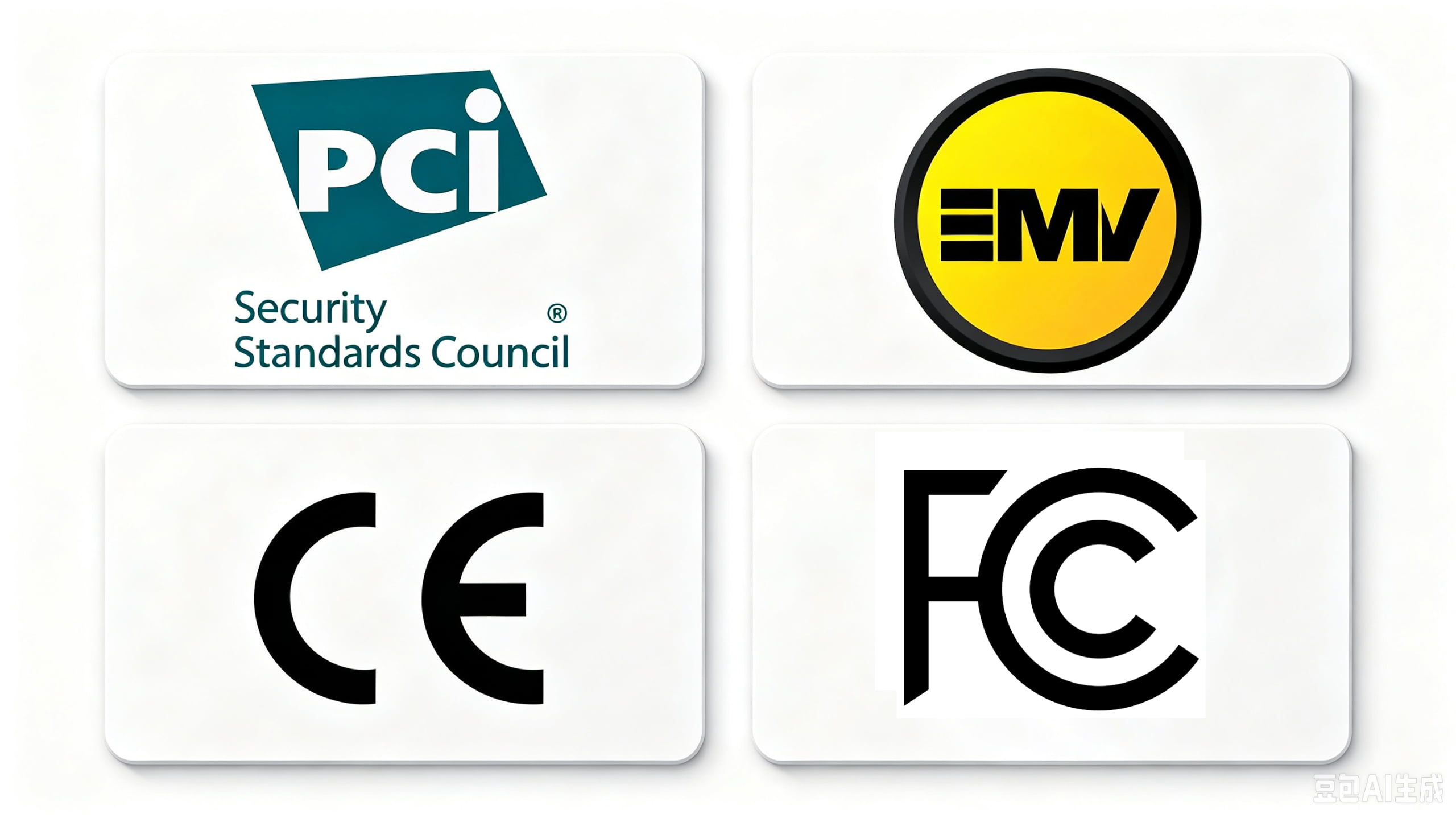
Table of Contents
- 1. Two Separate Tracks: Hardware Compliance vs Payment Approval
- 2. Electromagnetic Compatibility: FCC, CE, and Regional Equivalents
- 3. Electrical Safety and Battery Transport
- 4. Materials and End-of-Life: RoHS and WEEE
- 5. Software Ecosystem Standards (GMS and Its Alternatives)
- 6. The Documentation Checklist to Request From a Factory
- 7. Frequently Asked Questions
1. Two Separate Tracks: Hardware Compliance vs Payment Approval
The single most common mistake in hardware sourcing is treating compliance as one list. It is two, and they are owned by different parties.
Electromagnetic compatibility, electrical safety, and material restrictions. These apply to every device a factory ships — an industrial mini PC, a kitchen display, a kiosk enclosure, or a receipt printer. They are what customs and market regulators check, and they are the manufacturer's responsibility to document.
Applies only to devices that physically read a card. The rules and approval paths here are set by the card networks and your acquiring bank, not by the hardware factory. If your device does not take payments, this track is not yours at all — and if it does, the scope and sequence are decisions for your acquiring partner.
The rest of this guide stays on Track A. When a buyer asks a manufacturer to "supply certified hardware," they are almost always asking about Track A documentation — and Track B is a conversation for the acquirer and the payment software provider.
2. Electromagnetic Compatibility: FCC, CE, and Regional Equivalents
Anything that transmits or switches electrically must be tested for electromagnetic compatibility (EMC). In practice this means two things: the device must not emit interference that disrupts other equipment, and it must keep functioning in the presence of interference and static discharge. A POS terminal packs Wi-Fi, Bluetooth, and sometimes cellular radios into a small metal-and-plastic chassis, which makes this a genuinely difficult test to pass.
FCC governs the United States, CE the European Economic Area. Both verify emissions limits and immunity. CE additionally carries a Declaration of Conformity that the manufacturer signs, naming the directives applied.
Other markets require their own marks — Japan, China, Australia, and Brazil each run national schemes. A device approved for the US is not automatically cleared for Japan.
3. Electrical Safety and Battery Transport
Two areas where retail hardware sourcing goes wrong most often involve power, and they are both physical-safety questions rather than performance questions.
Lithium-ion cells that ship internationally are subject to dangerous-goods transport rules, and the paperwork differs between shipping a device with the battery installed, with it packed separately, or shipping loose cells. Undocumented batteries are a routine cause of shipments being held at customs. Ask the factory which configuration and documentation they ship under.
The external power adapter is frequently a separate component from the device, and it is the part that carries the safety approval. Confirm that the adapter supplied for your market matches your mains voltage and plug type, and that the adapter itself is listed — a compliant terminal paired with an unlisted brick is still a compliance problem.
4. Materials and End-of-Life: RoHS and WEEE
Restricts hazardous substances such as lead, mercury, and certain flame retardants in the finished product. Required for the European market and increasingly demanded elsewhere as a baseline sourcing condition.
Governs take-back and disposal obligations for electronic equipment. Where you sell determines who registers and who funds collection, so this is a commercial question as much as an environmental one — settle it with your distributor before the first shipment.
5. Software Ecosystem Standards (GMS and Its Alternatives)
For Android POS systems, the relevant question is not a safety mark but which software ecosystem the device is built against. A device carrying the Google Mobile Services stack behaves differently from an open-source build in ways that affect your deployment:
- With the Google services stack: you get the Play Store, Google APIs for location and push notifications, and documented compatibility with common device-management platforms used to administer large fleets.
- Open-source builds without it: applications are deployed directly to the device rather than through a storefront, which changes how you handle updates and how you audit what is running on a terminal in the field.
Neither is inherently better. What matters is that the choice is made deliberately and matched to your deployment tooling, because switching later means re-imaging the fleet.
6. The Documentation Checklist to Request From a Factory
Compliance is not a claim, it is a document set. Before signing a hardware contract, ask for these by name — a supplier who holds them can produce them the same week.
Approvals are issued per model and per configuration. A certificate for a similar chassis does not cover the variant you are ordering, especially when the radio module or power supply differs.
List the countries you will sell into and ask the manufacturer to confirm coverage country by country, naming the specific mark for each. Regional schemes do not substitute for one another.
Approvals are issued to a named legal entity, which may be the factory, a component supplier, or a third party. Confirm the holder is the party you are contracting with, and ask for the certificate number so you can check it at the issuing body.
Get the adapter listing for your mains type and the shipping configuration for cells in writing. These are the two items most likely to delay a first shipment.
For Android devices, establish which services stack the device runs and how fleet updates are delivered before the order, not after the devices arrive.
Frequently Asked Questions
Which certifications does POS hardware need?
Every powered device needs electromagnetic compatibility and electrical safety approvals for each market it is sold into, typically FCC for the United States and CE for Europe, plus material and end-of-life compliance such as RoHS and WEEE. Devices that read payment cards also fall under payment-scheme approval, whose scope is set by the card networks and your acquiring bank rather than by the hardware factory.
Does my device need approvals if it never touches a card?
Yes. A kitchen display, an industrial mini PC, or a self-service kiosk still transmits and switches electrically, so electromagnetic compatibility and electrical safety approvals apply. Material restrictions like RoHS apply as well. These devices simply have no payment-scheme track to worry about.
What happens if hardware reaches customs without the right documentation?
Shipments can be held or refused when the required approvals for the destination market are missing, and the resolution is paperwork the factory has to supply — which means delay, not a workaround. Battery shipments are a frequent trigger because the transport documentation depends on how the cells are configured and packed. Verify the document set before dispatch rather than after arrival.
Is a certificate for one model valid for a similar one?
Generally no. Approvals are tied to a specific model and configuration. If the radio module, power supply, or chassis differs, the approval for the neighbouring model does not automatically transfer. Ask for the documents naming the exact variant you are ordering.
How long does hardware compliance testing take?
Timelines vary with the number of markets and the complexity of the radios involved, and a failure at any stage sends the model back for a hardware revision and a fresh test cycle. When comparing suppliers, the useful question is not a generic duration but which markets this specific model is already documented for — an existing approval you can verify is worth more than a projected schedule.
Who is responsible for payment-scheme approval on a device we white-label?
The scope, sequence, and ownership of payment-scheme approval are determined by the card networks and your acquiring bank, and they should be settled directly with those parties because the obligations follow the entity that accepts the transaction. This is deliberately outside the hardware-manufacturing conversation, and any supplier who offers to resolve it for you is overstating what they control.
Sourcing Hardware With the Paperwork in Order
TillNode builds POS terminals, kiosks, printers, and industrial computing hardware for white-label and OEM/ODM programs, and supplies the compliance documentation for the markets you sell into. Tell us your destination countries and we will confirm which approvals apply to the model you need.
Request a QuoteRelated reading: OEM/ODM manufacturing — how a white-label hardware program runs; industrial mini PCs — the non-payment device most often sourced across borders; what a credit card reader is — how card reading works at the point of interaction; POS hardware requirements for cloud POS software — specifying hardware for a software platform.