Every distributor, POS software vendor and system integrator eventually runs the same search — who can actually build this hardware, at our volume, to our spec, without the relationship falling apart at the third reorder.
The search returns thousands of companies describing themselves as POS hardware manufacturers. A far smaller number own the tooling, control the SMT process, and can quote a batch yield. Most procurement projects do not fail on unit price; they fail in the eighteen months after the first container, when a driver conflict surfaces, a model is quietly discontinued, or the firmware baseline drifts between shipments.
This guide sets out the checks that separate a factory from a reseller, the capability numbers worth asking for, and how to structure a first order so that the second one is straightforward.
What a POS hardware manufacturer actually does
A POS hardware manufacturer is an organization that designs and produces point-of-sale equipment — terminals, kiosks, cash drawers, printers, scanners, displays and the industrial computers behind them — and owns the production capability to do so. That last clause carries the weight. "Designs and sells" is a different business from "designs and builds".
The market contains three adjacent business types that are frequently mistaken for manufacturers:
- A trading company. Holds no tooling and no line. It quotes from a price list supplied by someone else, places a purchase order, and arranges shipment. Useful for catalog purchases; exposed when you need a firmware change or a component substitution mid-project.
- A software vendor. Sells a POS platform and bundles a rebranded terminal with it. The hardware is a convenience, not a competence — and it is usually sourced from whichever factory offered the most favorable terms that quarter.
- A brand aggregator. Licenses a name onto third-party hardware. The engineering decisions are made elsewhere.
None of these are illegitimate businesses. They are simply the wrong counterparty when what you need is control over the device that carries your brand.
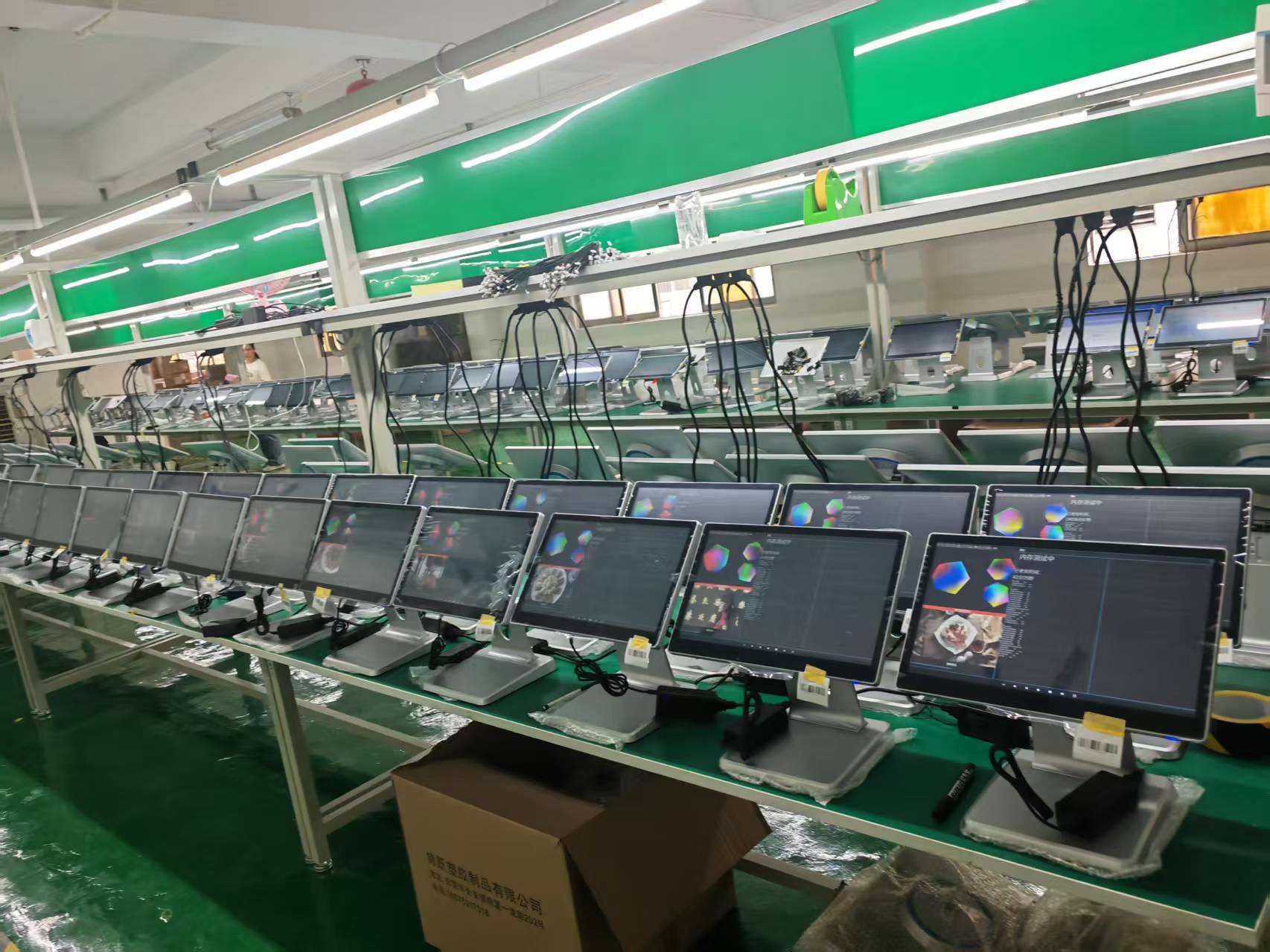
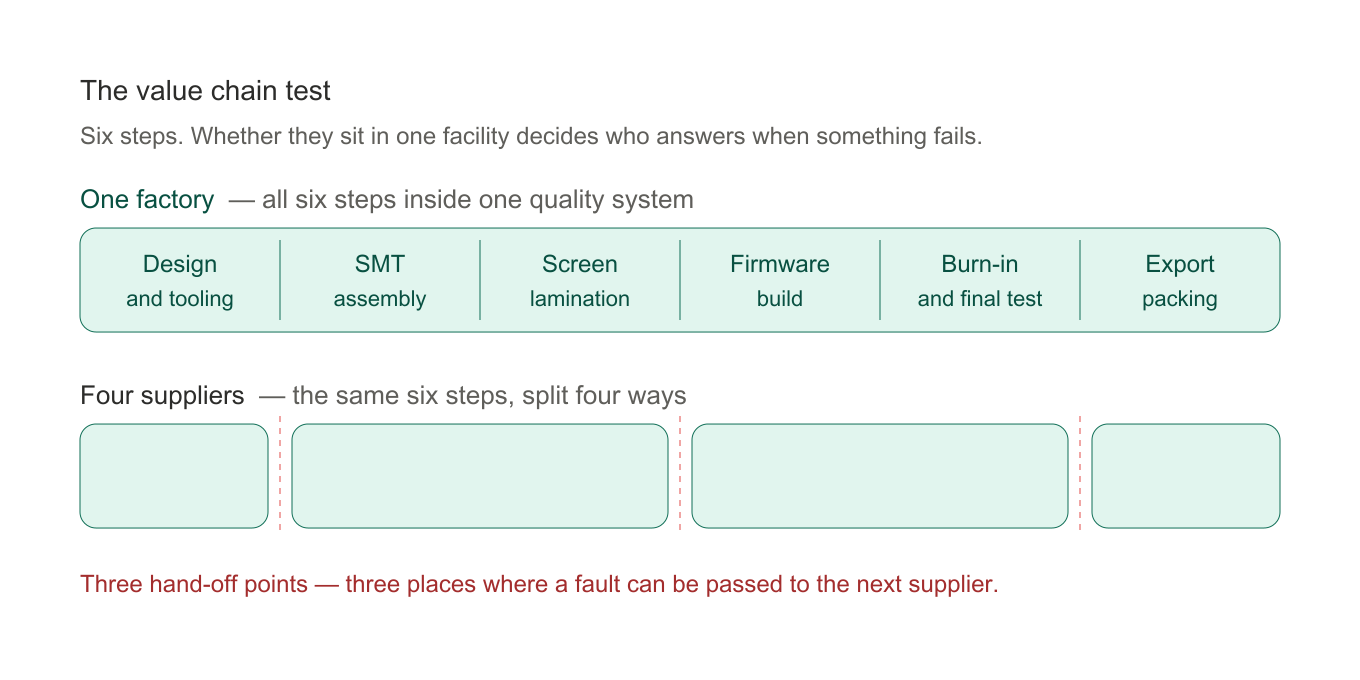
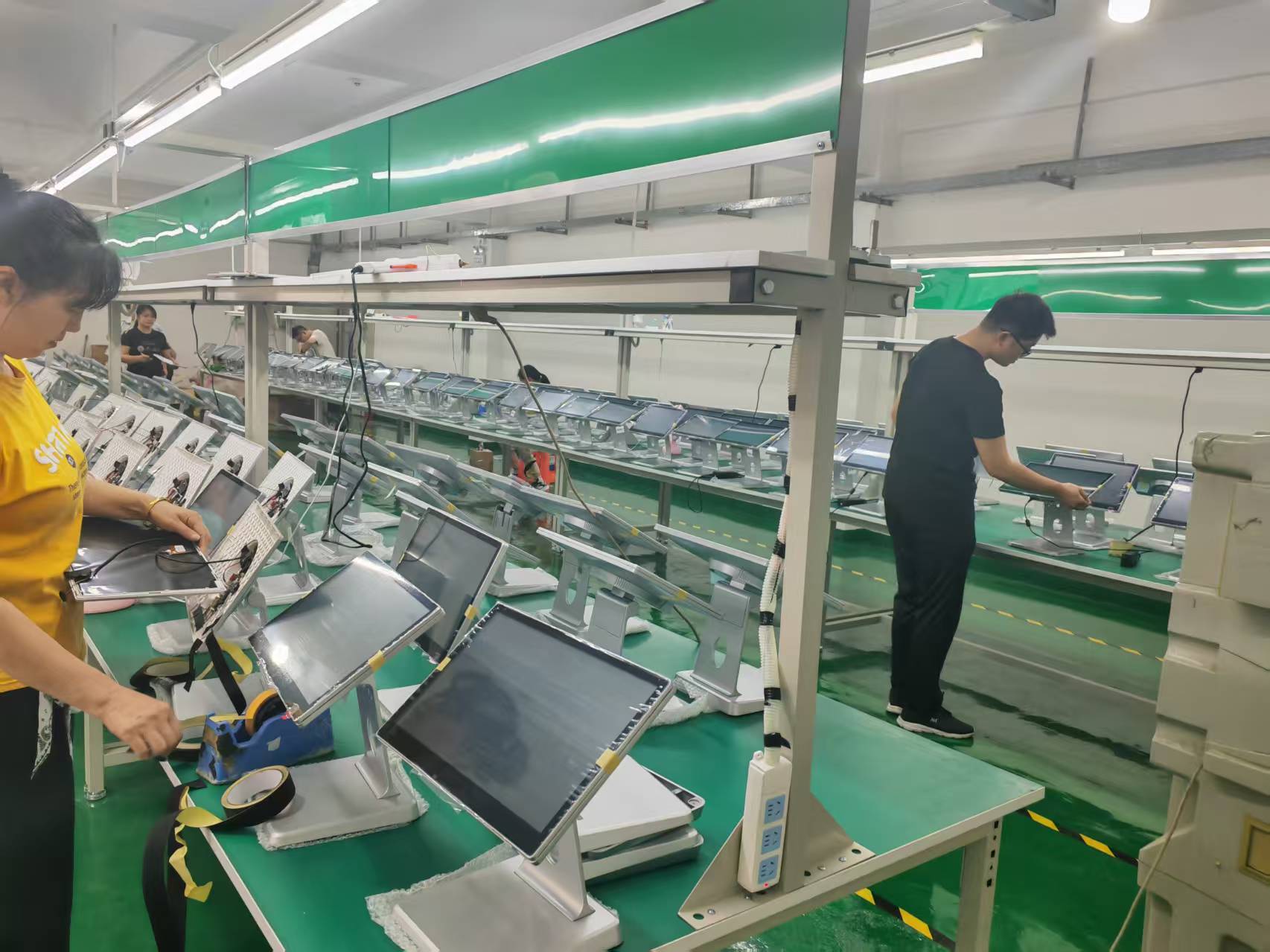
The practical test is the value chain. In a genuine manufacturing operation, industrial design, tooling, assembly, screen lamination, firmware build, burn-in, final test and packaging all sit inside one facility, under one quality system — with SMT either in-house or held at a single qualified partner line under the same process file. When those steps are split across four suppliers, every interface becomes a place where responsibility can be dropped — and when a customer reports a fault, you will be the one holding the conversation.
A note on how to read the rest of this guide. Everything below can be checked without specialist knowledge. You do not need to understand SMT process control to ask who runs the line and what the last batch record shows. The questions matter more than the answers you expect.
Four questions that separate a factory from a reseller
Four questions, asked in the first call, will classify almost any supplier. None of them require a factory visit; all of them become hard to fake once you ask for documentation.
- Who owns the tooling? Ask for the mold number and the panel supplier for the model you are discussing. A manufacturer can answer immediately. A reseller will offer to "check with the factory" and return with a brochure.
- Can you send the process diagram, not the catalog? The process diagram shows where the board is populated, where the screen is bonded, where burn-in happens and where final test sits. If the diagram is essentially a purchase order flow, you are talking to a trader.
- What was the first-pass yield on the last batch, and who measures it? Yield is an internal production figure, measured at the end of the line. A supplier with no line has no yield to report — only a supplier's promise.
- Who maintains the firmware baseline after the third reorder? Version control — golden samples, locked firmware baselines, a bill of materials that does not drift between shipments — is the discipline that keeps a supply relationship intact past the honeymoon period. Ask how builds are frozen, and how long a given image can be reproduced.
A supplier that answers all four with specifics is a candidate. A supplier that answers two and deflects the rest is worth keeping for a catalog order and not for a branded program.
The capability numbers worth asking for
Once a supplier passes the four questions, the next step is a capability sheet. The table below lists the figures that actually predict whether a program will hold together at scale, and why each one matters.
| Capability | What to ask for | Why it predicts the outcome |
|---|---|---|
| Factory area and site | Total floor area, and whether production is on one site or split across workshops | Split sites multiply handling, damage and lead-time risk; a single site keeps one quality system accountable |
| SMT lines in-house | Number of placement lines, and whether board population is outsourced | In-house SMT is what makes an engineering change possible without a third party's calendar |
| Assembly and ESD control | Assembly lines, and the antistatic class of the assembly area | Static damage produces failures that only appear in the field, weeks after the batch ships |
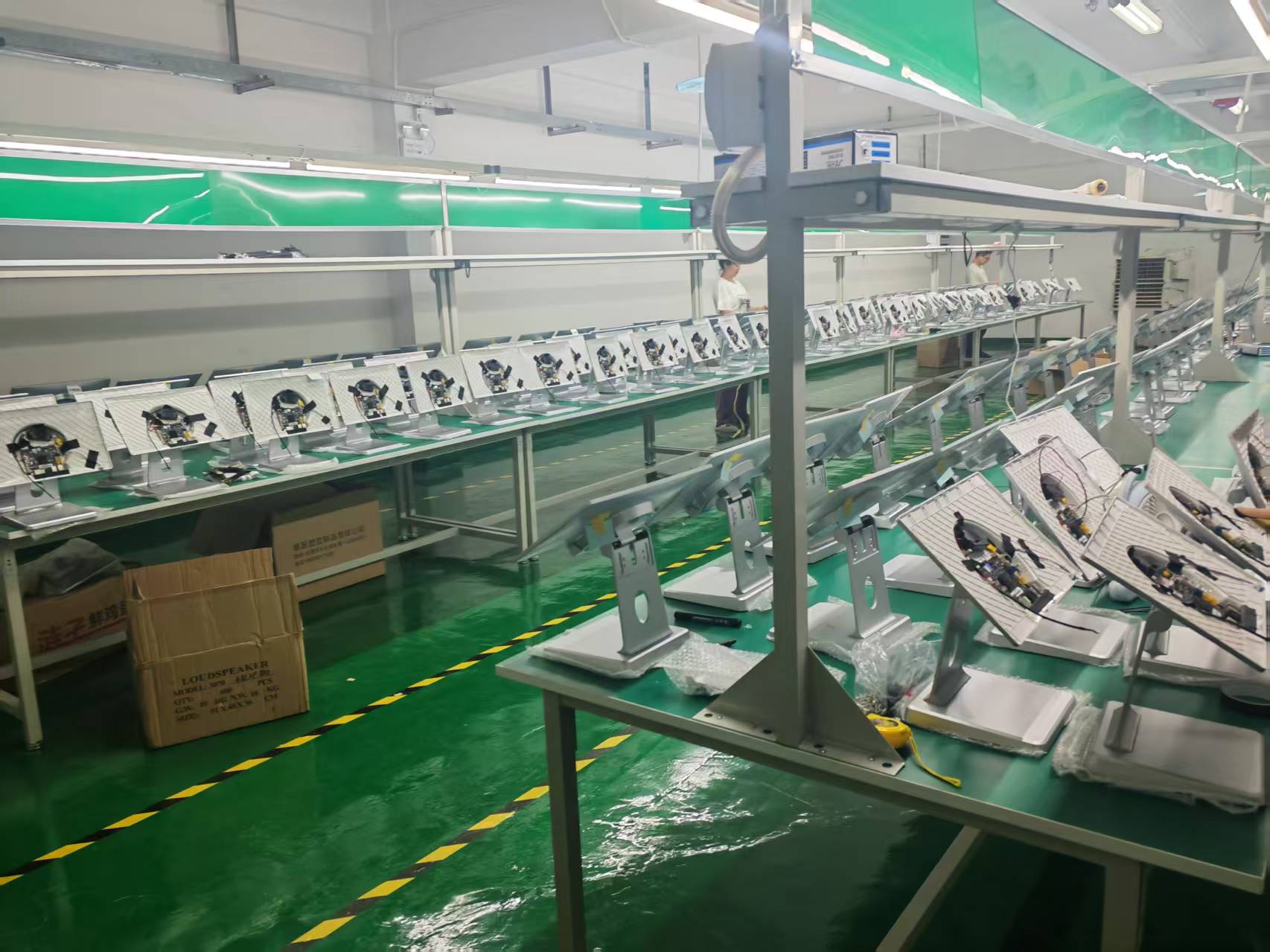
| Burn-in protocol | Duration, temperature, and what percentage of units are aged | Early-life failure is the most expensive kind; aging removes it before it leaves the building |
| Environmental and drop testing | Whether thermal, humidity, drop and ingress tests are run in-house, and the standards applied | Retail hardware meets spilled coffee and loading docks; these tests decide whether it survives them |
| First-pass yield | A percentage for the last quarter, plus how it is measured | A published yield is the strongest single signal of process control |
| Monthly capacity | Units per month by product line, and the headroom above current load | Capacity is what your rollout schedule is actually betting on |
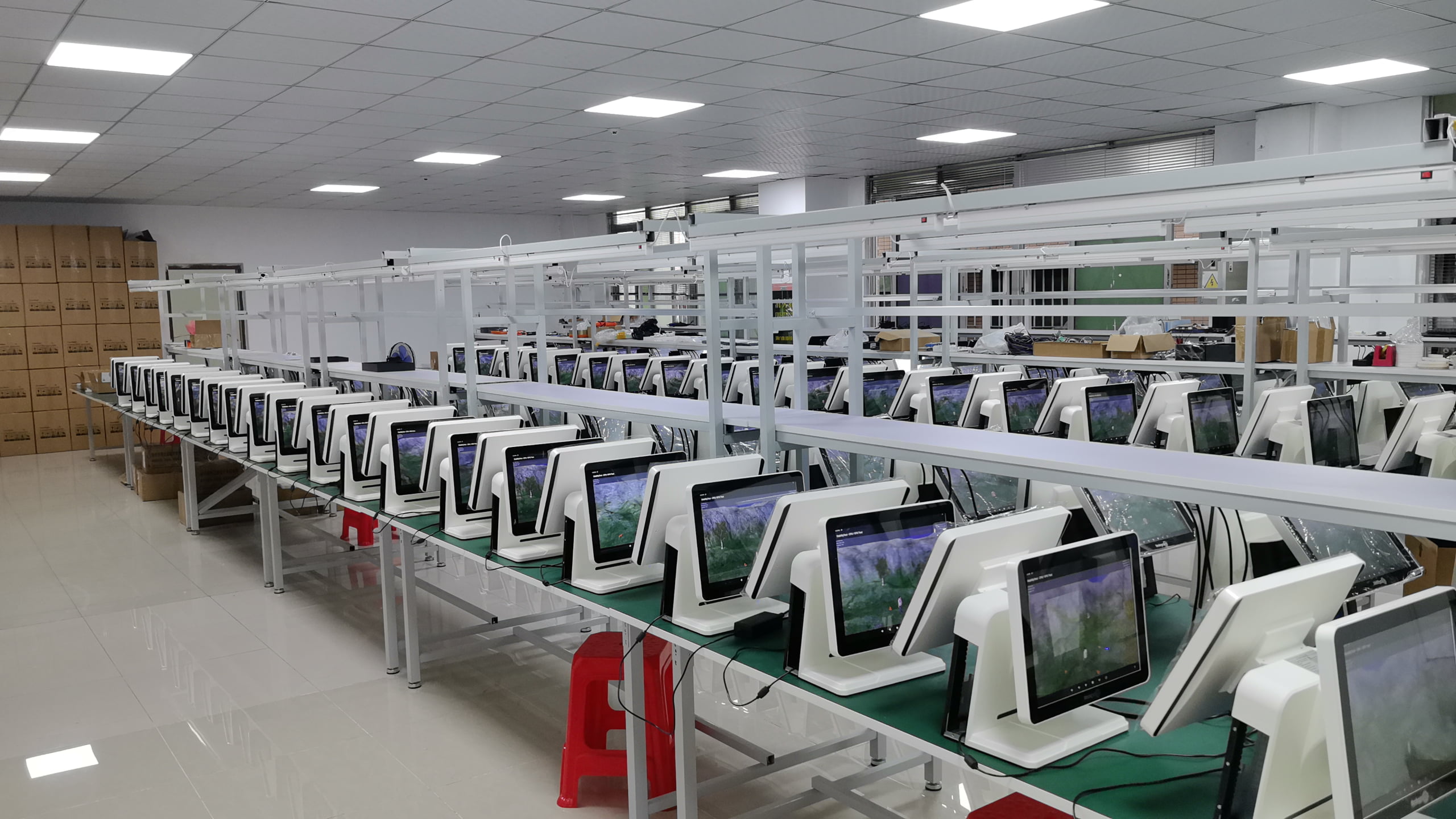
As a reference point for the range these figures fall into: a mid-size Shenzhen factory supplying retail and hospitality projects typically operates from a site of several thousand square meters, places SMT at one qualified partner line while keeping assembly, burn-in and final test in-house, ages every computing unit for at least 48 hours at 50 °C before shipment, and samples each batch to a published AQL. For example, one such facility in Shiyan, Shenzhen — founded in 2019, with 120 production operators across four assembly lines — occupies 5,400 m², keeps a cleanroom assembly area for screen bonding, ages every computing node for 48 hours at 50 °C, samples each batch to AQL II, and quotes capacity around 20,000 units per month. See how that factory is laid out.
Certifications and compliance: verify reports, not badges
Certification badges appear on nearly every supplier homepage. What matters is not whether a logo is displayed but whether a document can be produced on request — and whether that document covers the specific configuration you intend to ship.
Certifications that apply to most POS hardware programs
| Mark | Scope | What to request |
|---|---|---|
| ISO 9001:2015 | Quality management system | Certificate number, issuing body and expiry date |
| CE | European market access | The test report and Declaration of Conformity for your configuration |
| FCC | United States, radio and emissions | FCC ID and the associated test report |
| RoHS | Restricted substances | Material declaration covering the full bill of materials |
| IP rating | Ingress protection | The ingress protection test report, particularly for counter and kitchen equipment |
| Regional marks | BIS (India), ANATEL (Brazil), KC (South Korea), NOM (Mexico), UKCA (UK) | Whether the factory scopes and manages these as a program service, or expects you to |
Two practical points save a great deal of time. First, ask about platform reuse: where a core board and chassis are already assessed for a market, re-branding frequently reduces to updating a Declaration of Conformity rather than commissioning a full test cycle. Second, ask who pays for and manages market-specific marks. A factory set up for export will treat this as a routine project line item; a reseller will hand it back to you.
Payment-security approvals sit in a separate category, governed by the card networks and the acquiring side of your project rather than by the hardware vendor alone. If your deployment involves card acceptance, scope that work explicitly with your payment partner before the hardware order is placed — it affects component selection, key management and enclosure design.
OEM, ODM or white label — which program fits
Once a supplier passes the capability checks, the commercial question becomes how much of the design you want to own. The three common structures differ in who holds the specification, the tooling and the certification.
| Program | Who defines the hardware | Typical use | What you carry |
|---|---|---|---|
| White label | The factory; you select from existing platforms | Fast entry into a market, catalog builds | Branding, packaging, warranty and support |
| ODM | The factory, against your functional brief | Differentiated product with no internal engineering team | The brief, the brand, and the market-facing commitment |
| OEM | You, or you jointly with the factory | Multiple product lines, custom I/O, own firmware roadmap | Design ownership, tooling investment, certification scope |
The right answer is usually driven by how many units you expect to move and how much of the commercial risk you want to hold. A white-label program is the correct choice for a first market test; an OEM program only pays back once volumes justify tooling and NRE.
This distinction deserves more space than a paragraph, so we keep a separate, longer treatment of it: OEM vs ODM in POS manufacturing.
Why so much retail hardware is built in Shenzhen
Most retail hardware programs eventually evaluate a Chinese manufacturing partner — not because of unit cost alone, but because of how the supply base is arranged.
Shenzhen and the surrounding Pearl River Delta concentrate PCB fabrication, display panels, injection molding, toolmaking, connectors and power supplies within a short drive of one another. For a hardware program this produces three practical effects:
- Faster iteration. A revised enclosure or a different panel can be prototyped without waiting on a supply chain that spans continents.
- Lower tooling cost. Competitive toolmaking keeps the entry price for a custom program reasonable, which is what makes small first orders viable.
- Component resilience. When one part is short, an alternative supplier is often within the same industrial belt.
The region also concentrates the less flattering end of the market. Being located in Shenzhen does not make a company a factory, and the proportion of suppliers who are trading companies rather than manufacturers is highest in exactly the categories buyers search the most. Which returns the evaluation to the four questions in section two: tooling ownership, process diagram, batch yield and firmware baseline. Those checks work in Shenzhen, in Europe, and everywhere else.
The supplier that is easy to buy from is rarely the supplier that is easy to keep. Speed of quotation tells you about sales capacity. Documentation, yield figures and version control tell you about production capacity. Weight the second set more heavily than the first. Where those questions have produced three bids, reading three quotes side by side is the arithmetic that follows.
Selection checklist
Worth running against every shortlisted supplier. Two or more unanswered items is a signal to keep looking.
- Legal entity and site. Registered name, ownership of the production site, and whether design, assembly and testing share that site.
- Tooling and mold access. Mold numbers for the target model, and confirmation that they are held internally.
- In-house process coverage. Board population, screen lamination, final test and packaging under one roof.
- Quality system. ISO 9001:2015 certificate in date, plus the internal inspection gates between production stages.
- Test documentation. Burn-in protocol, thermal and drop testing, and ingress protection reports.
- Certification coverage. Reports available for your target markets, and a plan for any market not yet covered.
- Version control. How firmware images are frozen, and how long a given configuration can be reproduced.
- Commercial terms. MOQ ladder, pilot and sample policy, lead time, Incoterms, warranty and the RMA process.
- Spare parts and continuity. Availability of spares, and the model lifecycle policy for the platform you have chosen.
- Reference and audit. Willingness to arrange a live video tour or accept a third-party audit before the order.
Cost, MOQ and lead time: what the numbers look like
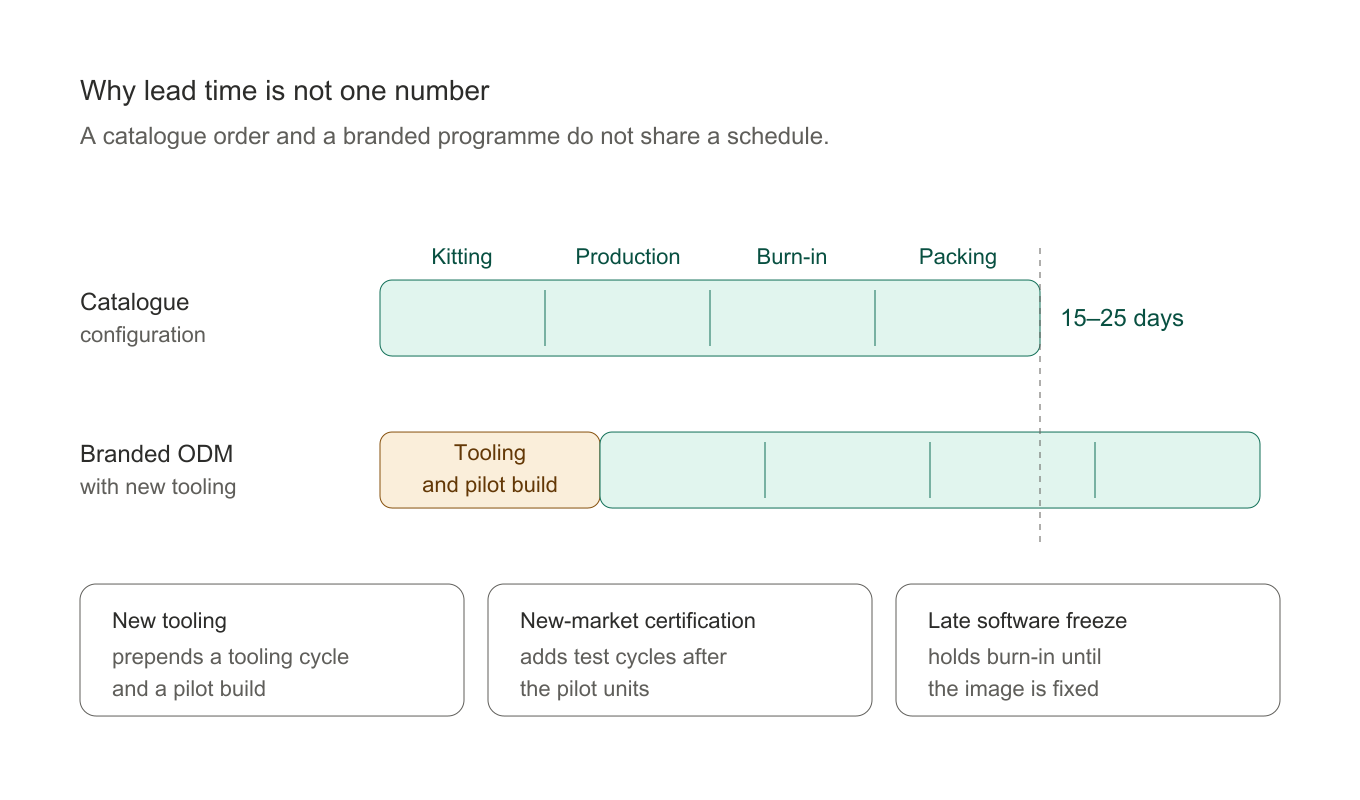
Buyers usually arrive with two assumptions that make the first conversation harder than it needs to be: that unit price falls smoothly with volume, and that lead time is a single number. Neither holds.
Indicative factory-side pricing bands
Prices below are indicative B2B ranges for factory-side supply, before local duties, certification costs for new markets and freight. Actual quotations move with specification, component market conditions and order size.
| Product category | Indicative band (per unit) | Notes |
|---|---|---|
| Compact Android POS terminal | Low three figures | Highest volume, most standardized category |
| All-in-one touch POS terminal | Low to mid three figures | Screen size, CPU tier and dual-display options drive the spread |
| Handheld smart POS with printer | Mid three figures | Ruggedisation and scanner grade are the main variables |
| Self-service or ordering kiosk | Four figures | Enclosure type and integrated peripherals dominate the cost |
| Electronic shelf label | Low two figures | Screen size and battery specification set the price floor |
| Fanless industrial Mini PC | Low to mid three figures | Processor generation and I/O count are the levers |
MOQ and lead time
- MOQ typically starts from 50 units on a platform the factory already builds, and accepts sample or pilot orders below that so hardware and software can be validated on your own stack before a full order. A fully custom motherboard raises the minimum, because the tooling and engineering cost has to be amortized.
- Lead time for catalog configuration commonly runs 10–15 days from confirmed order and deposit. Three factors extend it: new tooling, certification scope for a market not yet covered, and how late the software image is frozen. A branded ODM program with tooling and pilot production takes longer; a full OEM design with a custom board longer still.
- Warranty is normally 12 months on terminals and industrial computers, with extended service agreements available for multi-site fleets.
FAQ
How do I verify that a POS hardware supplier is a real factory?
Ask for the mold number of the model you are evaluating, a process diagram showing where each production stage happens, and the first-pass yield from the last batch. Then request a live video tour of the assembly floor, the cleanroom and the aging room. A manufacturer can arrange all three; a trading company typically offers a factory visit at a "partner site" and changes the subject on the yield question.
What is a normal MOQ for an OEM or ODM POS terminal?
On a platform the factory already produces, MOQ commonly starts at 50 units, with sample and pilot orders accepted below that for validation. A fully custom motherboard raises the minimum substantially because tooling and engineering costs must be recovered. It is worth separating the two in your first inquiry — you will get a much clearer answer.
Which certifications should a POS hardware manufacturer hold?
At minimum an ISO 9001:2015 quality management system, plus CE and FCC for Europe and North America and RoHS for material restrictions. Equipment destined for counter or kitchen environments should carry an ingress protection test report. For markets such as India, Brazil, South Korea or Mexico, confirm whether the factory manages the regional mark as a project service.
How long does an OEM or ODM POS program take from first inquiry to mass production?
Allow four distinct phases: specification and hardware matching, sampling and validation on your software, tooling and firmware freeze if the design is custom, then mass production. Catalog configuration with branding only can move in weeks; a custom-board program with new tooling is a multi-month project. Fixing the software image early is the single most effective way to compress the schedule.
Should I buy from a manufacturer or a distributor?
Buy from a distributor when you need a small quantity quickly, standard configuration, and local returns handling. Buy from the manufacturer when you need control: a specific configuration, your own branding, firmware changes, and a supply relationship that survives a model refresh. Many buyers start with a distributor and outgrow it within a year — at which point the evaluation criteria above become relevant.
Can a manufacturer print our brand and ship in our packaging?
Yes, and it is a standard part of OEM and ODM programs: screen printing on the housing, a custom boot logo and animation, tailored firmware defaults, branded packaging, your user manual and product labels. A well-run program ships units that carry no trace of the factory's own name.
Evaluating a manufacturing partner? We manufacture POS terminals, self-service kiosks, electronic shelf labels and industrial Mini PCs in our own facility in Shenzhen, and support OEM, ODM and white-label programs from a 50-unit pilot upward. Factory tours and video walkthroughs are welcome — request a quote or take a factory tour.
Related reading: OEM/ODM manufacturing programs · OEM vs ODM in POS manufacturing · How to test POS hardware before a bulk order · Quality and certifications