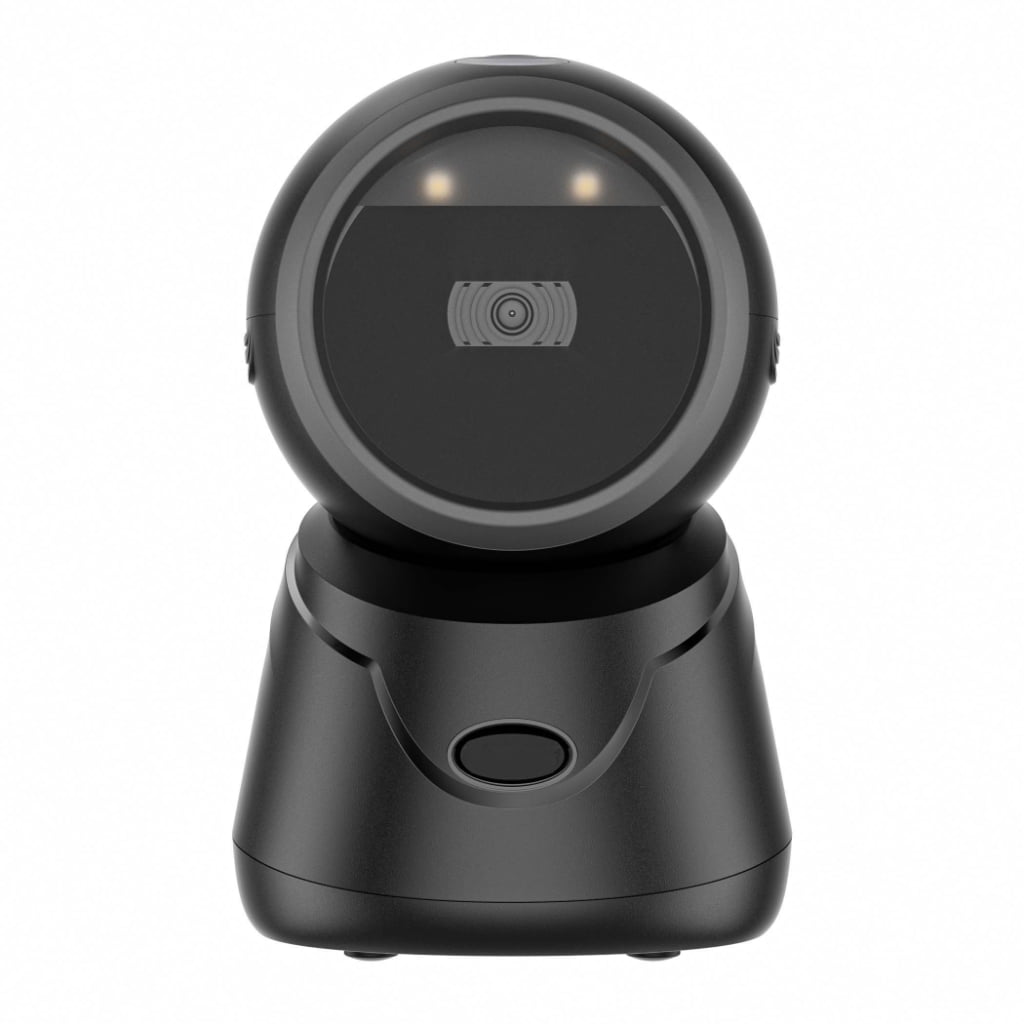
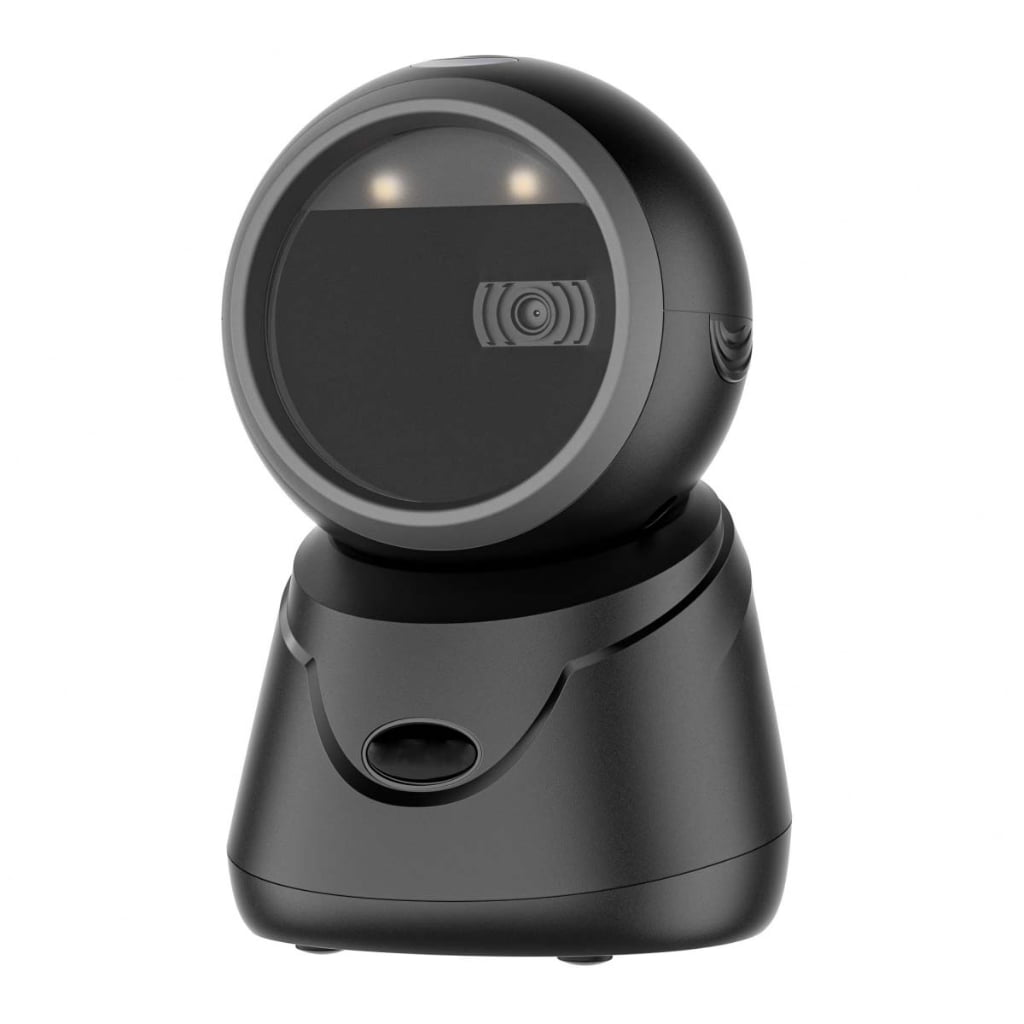
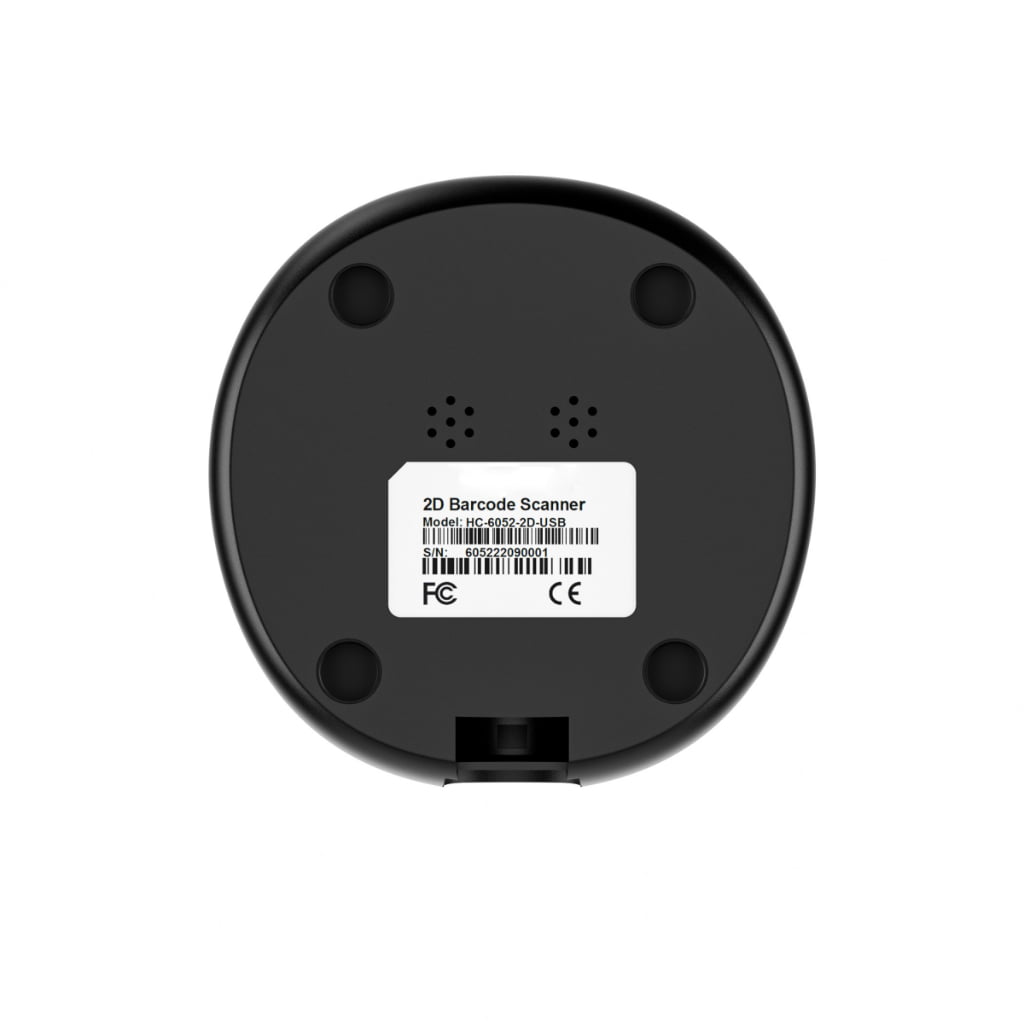
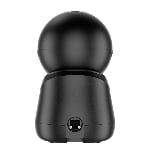
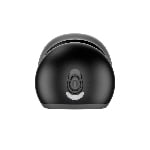
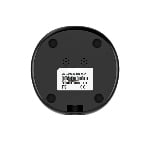
SN-HC6052 2D Desktop Barcode Scanner
Retail hardware specified for the work it actually does.
A 640 × 480 global-shutter imager that exposes every pixel at the same instant, so an item swung past the window still produces one usable frame. 159 mm tall with a 6–10° moulded lean, ±65° front-to-rear tolerance, and warm 3500 K illumination that does not glare off receipt paper.
- MOQ 1 with 10–15 day lead time on stock models
- Spec sheets and SDK released before the order
- 12-month warranty, OEM branding available on volume orders
- SKU
- SQN-SN-HC6052-2D
- Availability
- In Stock
- Lead Time
- 10-15 business days
- Warranty
- 12 months standard
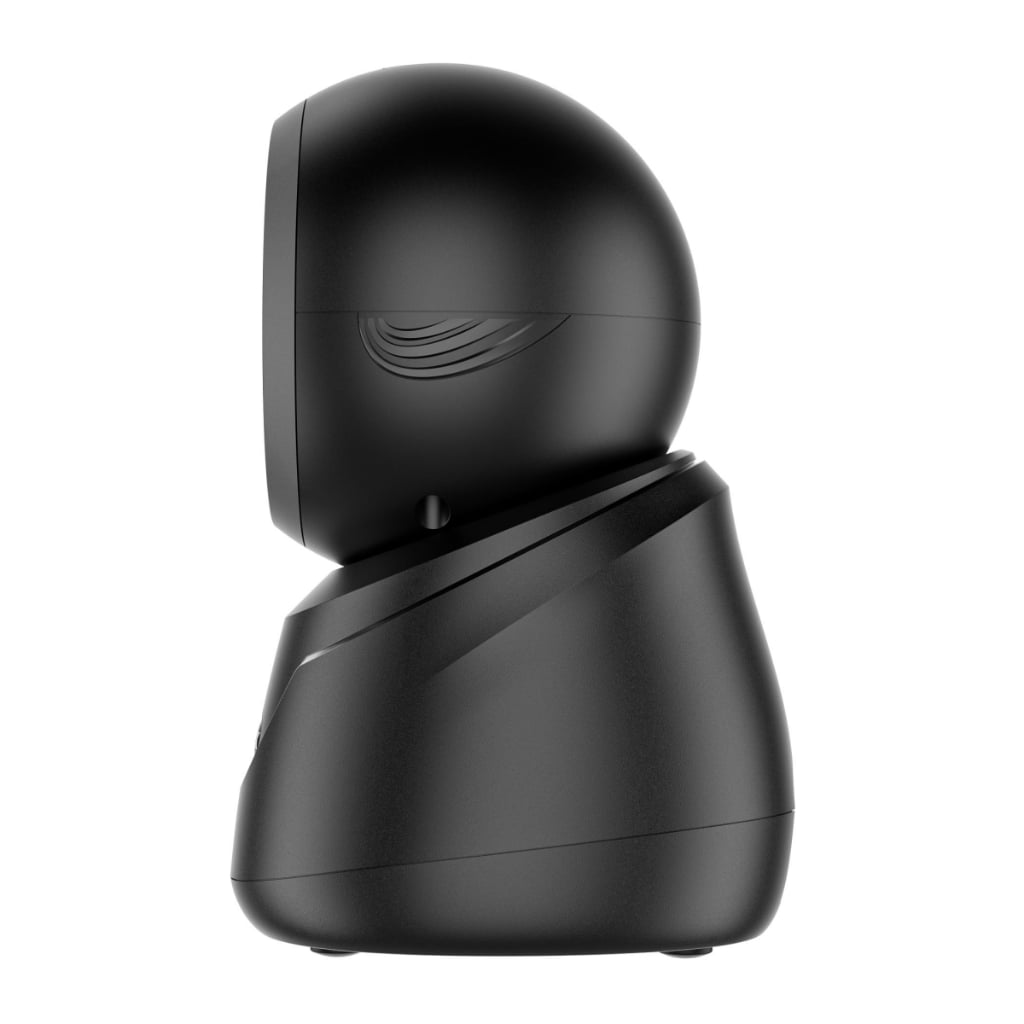
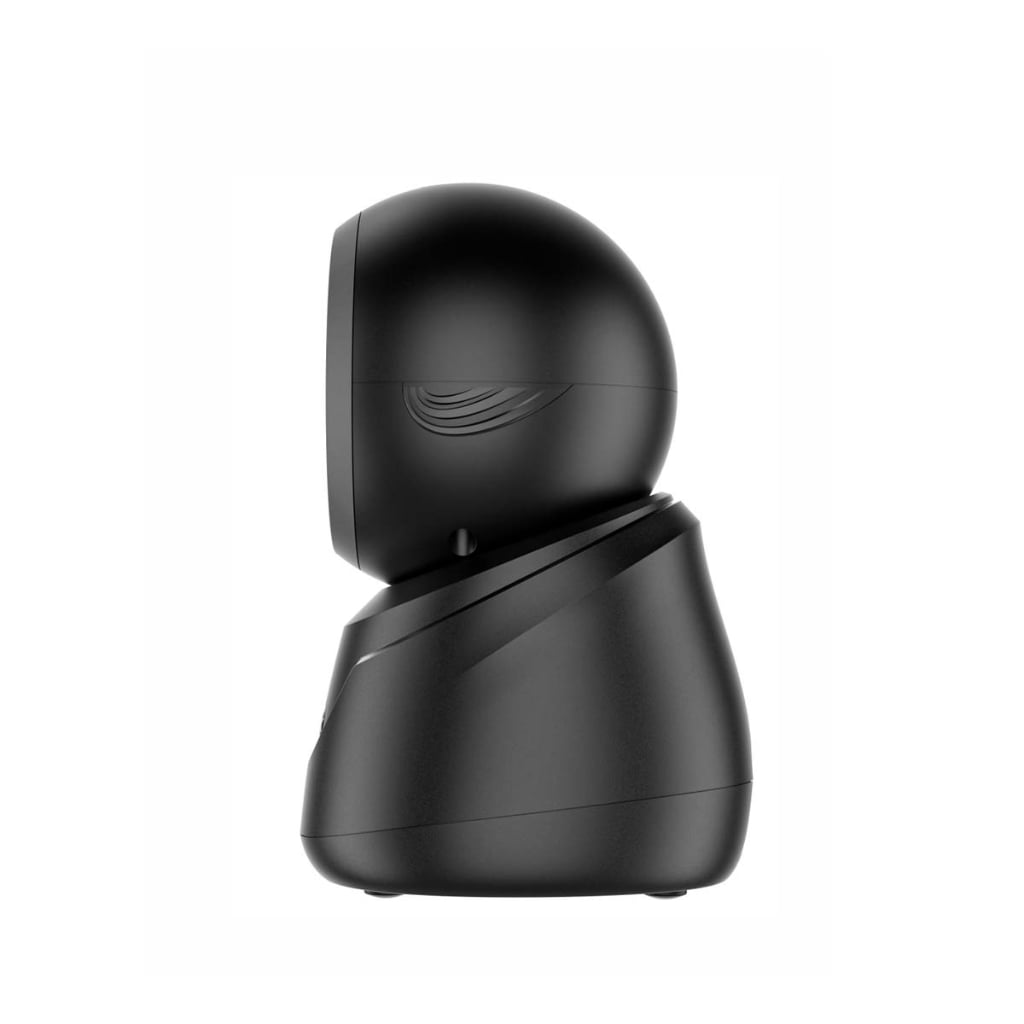
The SN-HC6052 is a presentation reader for lanes that already exist. It stands 159 mm tall on its own base, leans 6–10 degrees forward, and puts the scan window at the height where a basket handle naturally passes. Nothing about the counter has to change, and no bracket has to be fabricated.
The imager is a 640 × 480 CMOS sensor with a global shutter. That detail is the one that matters in a busy lane: a rolling-shutter sensor reads the image row by row, so anything moving quickly across the window produces a skewed frame that has to be thrown away and captured again. A global shutter exposes every pixel at the same instant, so a bottle swung past at speed produces one usable frame instead of three bad ones. Combined with ±65° of front-to-rear tolerance, it reads items coming in at an angle rather than straight on.
Illumination is a warm 3500 K LED rather than a white one. The practical difference shows up on thermal receipt paper and on the matte film used over some chilled goods, where a cooler light produces glare across the code; 3500 K is also less fatiguing under a counter canopy at the end of a long shift.
Core specifications
| Imager | CMOS with global exposure, 640 × 480 pixels |
|---|---|
| Frame rate | 30 fps |
| Field of view | 48° horizontal, 30° vertical |
| Scan angle | ±60° left/right, ±65° front/rear, 360° rotation |
| Body tilt | 6° to 10° fixed forward lean |
| Motion tolerance | 2 m/s maximum |
| Minimum element | ≥ 4 mil (Code 39) |
| Print contrast | More than 25% |
Depth of field
| UPC / EAN, 13 mil | 0–200 mm at PCS 90% |
|---|---|
| QR Code, 20 mil | 0–150 mm at PCS 100% |
Both figures are measured from the window face. In practice a cashier works inside the first 120 mm of that range, which is why a desk reader outperforms a handheld on a fixed lane: the distance never varies, so the decode never has to hunt.
Symbologies
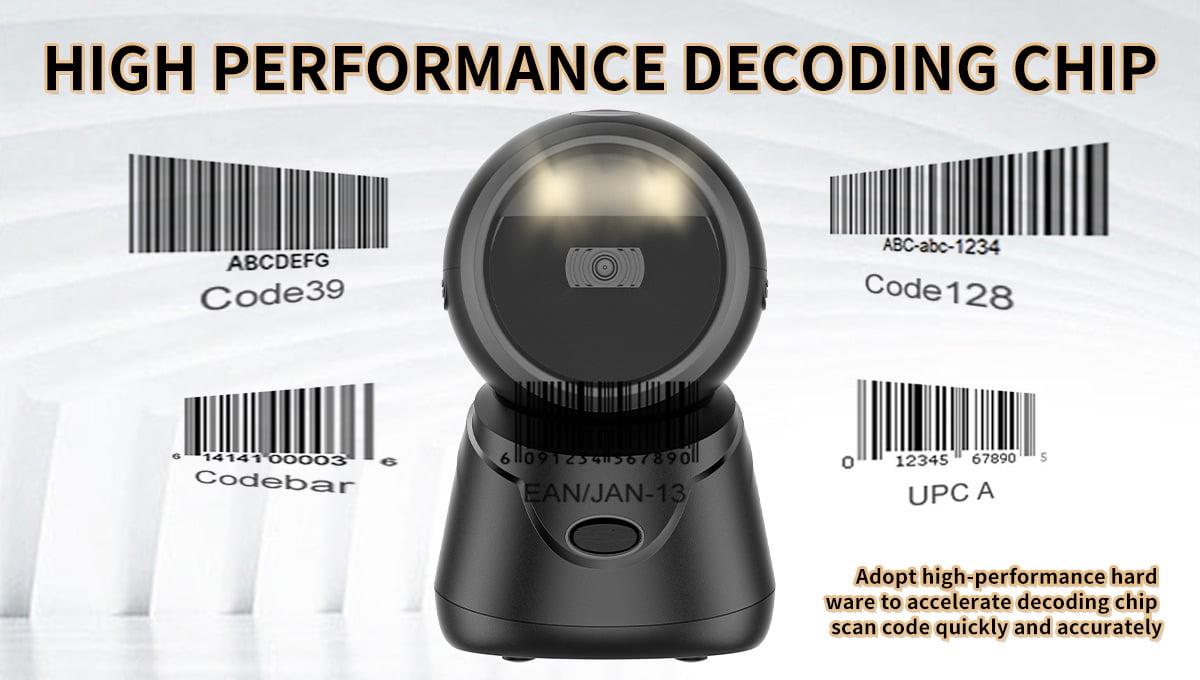
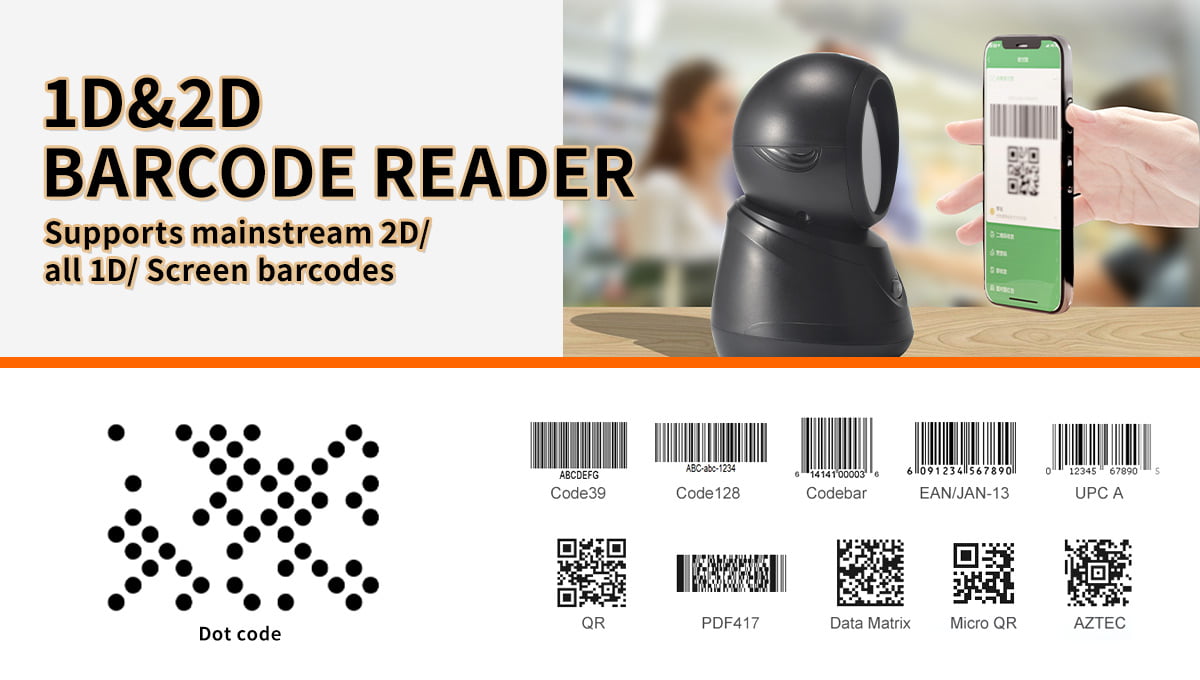
1D: UPC-A, UPC-E, EAN-8, EAN-13, JAN-8, JAN-13, ISBN, ISSN, Code 39 (full ASCII), Codabar (NW7), Code 128, EAN-128, Code 93, Interleaved 2 of 5, Addendum 2 of 5, IATA Code, MSI/Plessey, China Postal Code, Code 32 (Italian Pharmacode), RSS-14, RSS-Limited, RSS-Expand.
2D: QR Code, Data Matrix, PDF417, Aztec, MaxiCode, GS1 DataBar stacked.
The GS1 DataBar family is the one that gets overlooked in procurement. If the store sells loose produce or bakery goods weighed at the counter, those labels are almost always DataBar, not EAN. Confirm the format with the scale vendor before ordering — this reader handles all three DataBar variants, but the printer has to be emitting them in the first place.
Physical
| Dimensions | 101 × 102 × 159 mm (L × W × H) |
|---|---|
| Weight | 332 g including cable |
| Housing | ABS + PC |
| Cable | 1.8 m straight, standard |
| Indicators | Red and blue LED, plus buzzer |
| Light source | Warm white 3500 K LED |
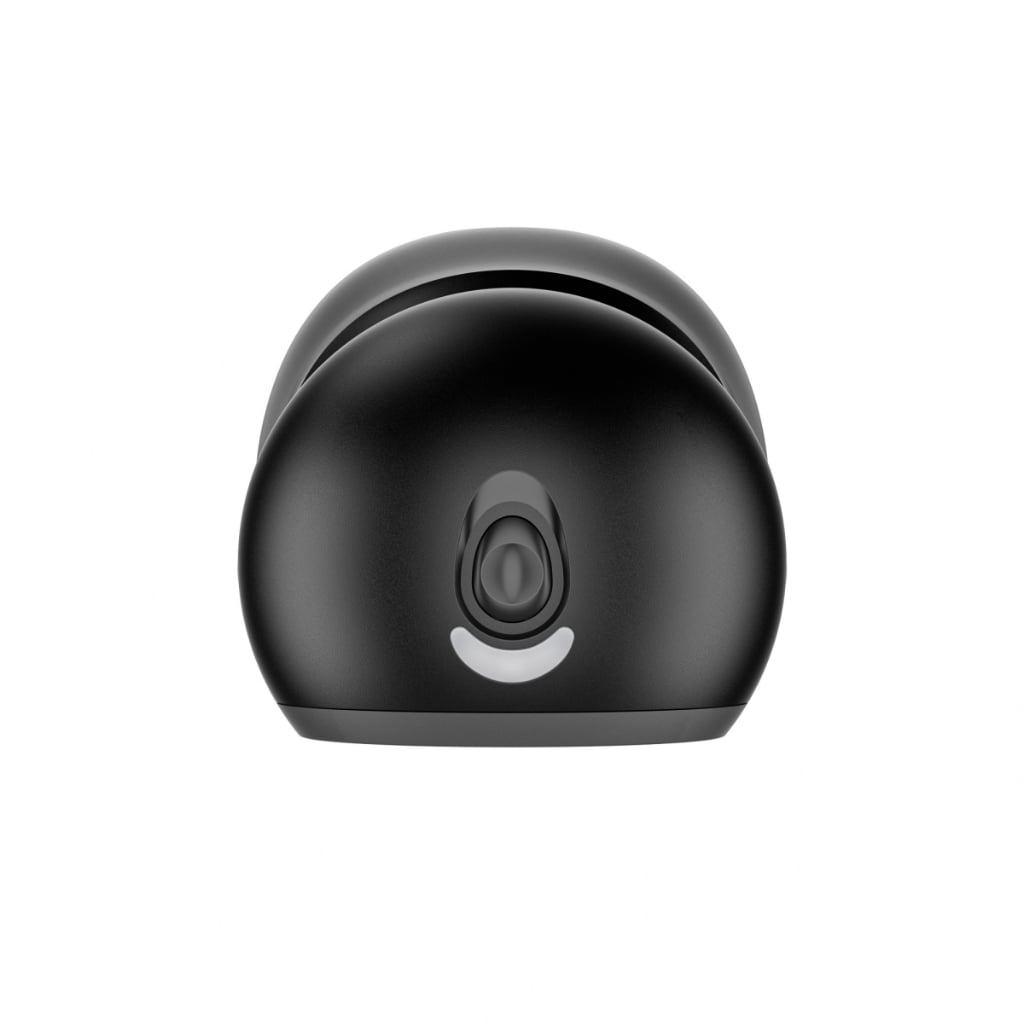
At 332 g with the cable, the unit is heavy enough not to slide when a basket knocks it and light enough that the double-sided tape under the base is sufficient for a permanent install. Two indicator colors let the software distinguish a good read from a rejected one without the cashier looking at the screen.
Power
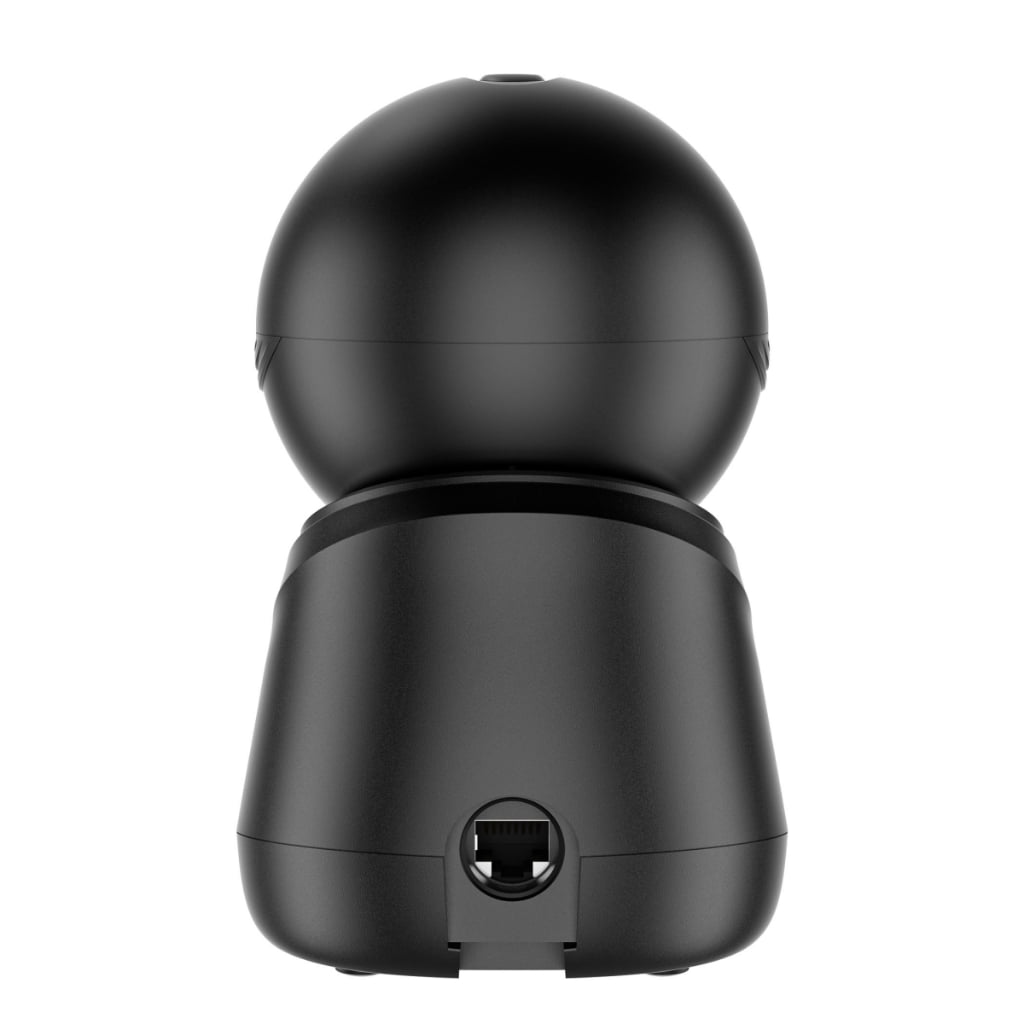
5 VDC ±5% at 250 mA typical. On the USB variants the whole requirement is met by the host port, so there is no wall adapter to find a socket for. On RS232 the cable carries a separate supply and the reader presents a standard serial device.
Environment
| Operating temperature | −20 °C to +60 °C |
|---|---|
| Storage temperature | −40 °C to +70 °C |
| Humidity | 5% to 95% RH, non-condensing |
| Drop resistance | 2 m |
| Ingress protection | IP52 |
| ESD | ±8 kV direct discharge |
| Ambient light | 0 to 100,000 lux |
The 100,000 lux ceiling covers a lane positioned directly under a skylight or next to a shopfront window. Below that, nothing in the environment affects the read rate.
Interfaces and setup
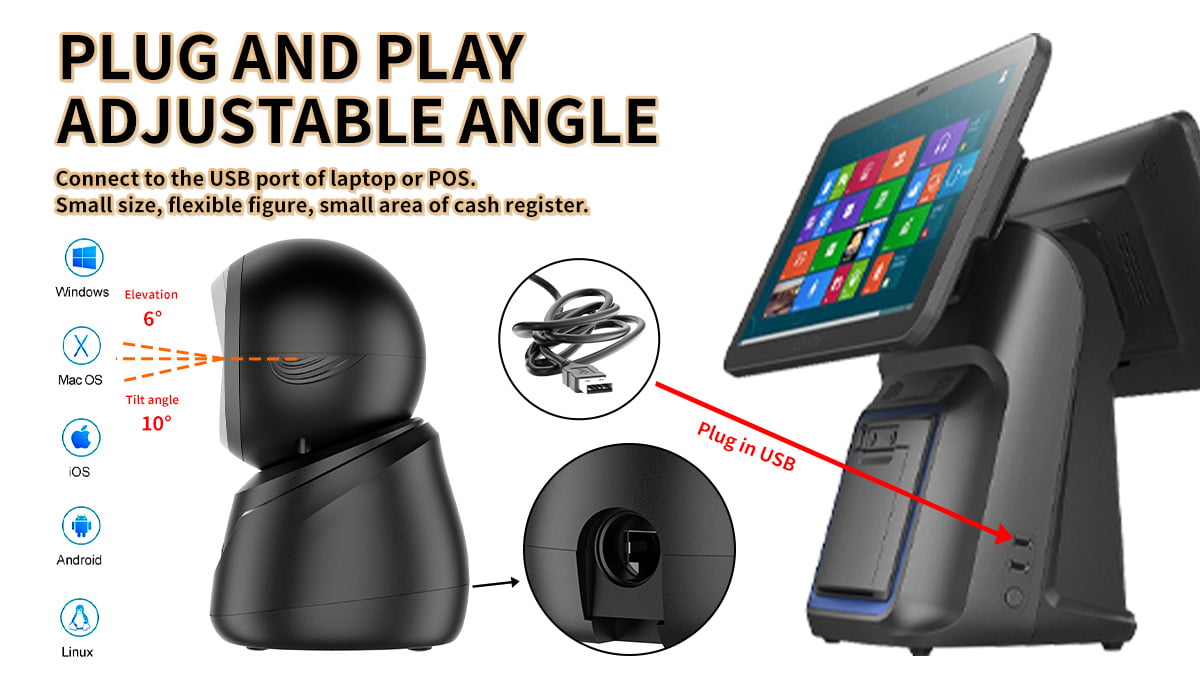
Three transmission modes ship on the same hardware: USB HID keyboard, USB virtual serial port, and RS-232. Selection is by configuration barcode, and the setting survives a power cycle. Windows, iOS and Android hosts are all supported — the iOS case is worth noting because it needs the HID or a camera-capable host, not a serial port.
Firmware updates happen over the same USB connection from a PC utility. There is no need to return a unit to change decode behavior, add a symbology or fix a host-compatibility bug.
Where it belongs
- Convenience stores and small chains. The 102 mm footprint fits beside a compact terminal without crowding the keyboard.
- Franchised retail. Identical unit across sites, three interface options, so one spare covers every branch configuration.
- Payment counters. Reads the QR on a phone screen and the printed order slip in the same session.
- Clinics and pharmacies. Data Matrix on medicine boxes for batch traceability, EAN for the till.
Limits worth knowing before you order
It is a wired unit — there is no battery option and no radio. It is a presentation reader, not a handheld: the body is not shaped to be picked up and pointed, and the base is not a charging cradle. And 4 mil is the resolution floor, so a code printed below that — micro-printing on electronics, for example — is outside what this sensor can resolve.
Compliance
CE to EN 55032:2015 and EN 55035:2017, EN 62368-1:2014+A11:2017, RoHS, BIS and FCC Part 15 Class B. Test reports are available on request with the order.
Ordering
SKU SN-HC6052. Specify interface at order: USB HID, USB virtual COM or RS232. Base and 1.8 m cable included. MOQ 1, 10–15 days on standard configuration, OEM branding from 50 units, custom cable length from 500 units.
Product images
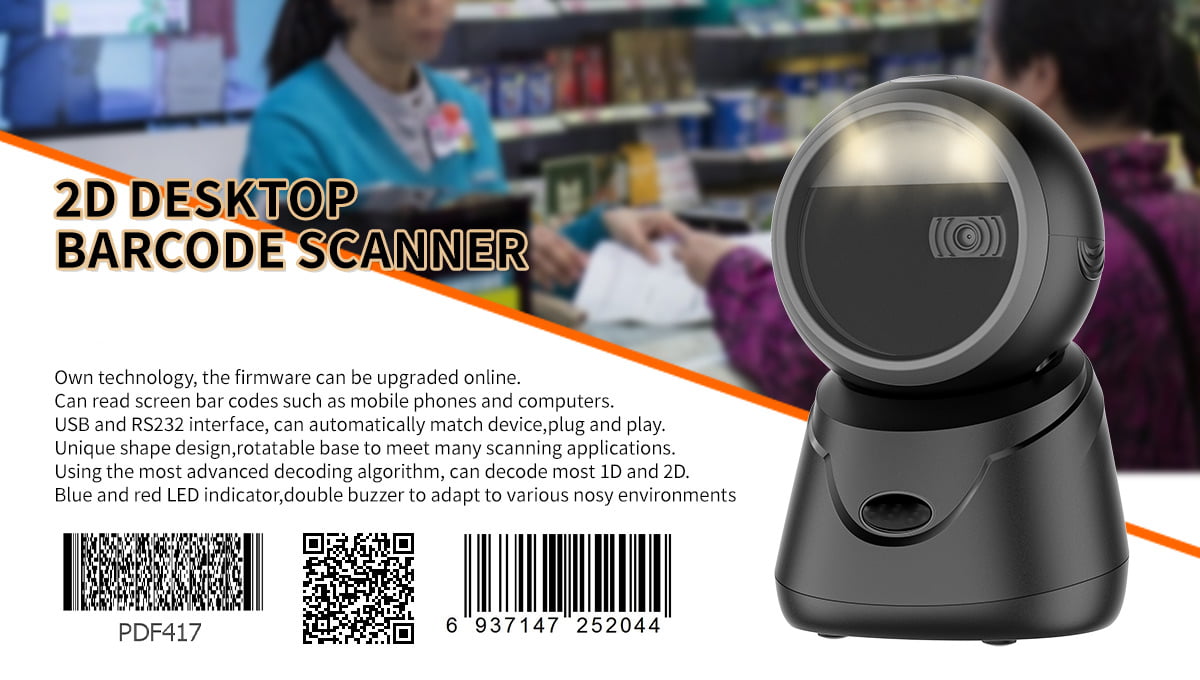
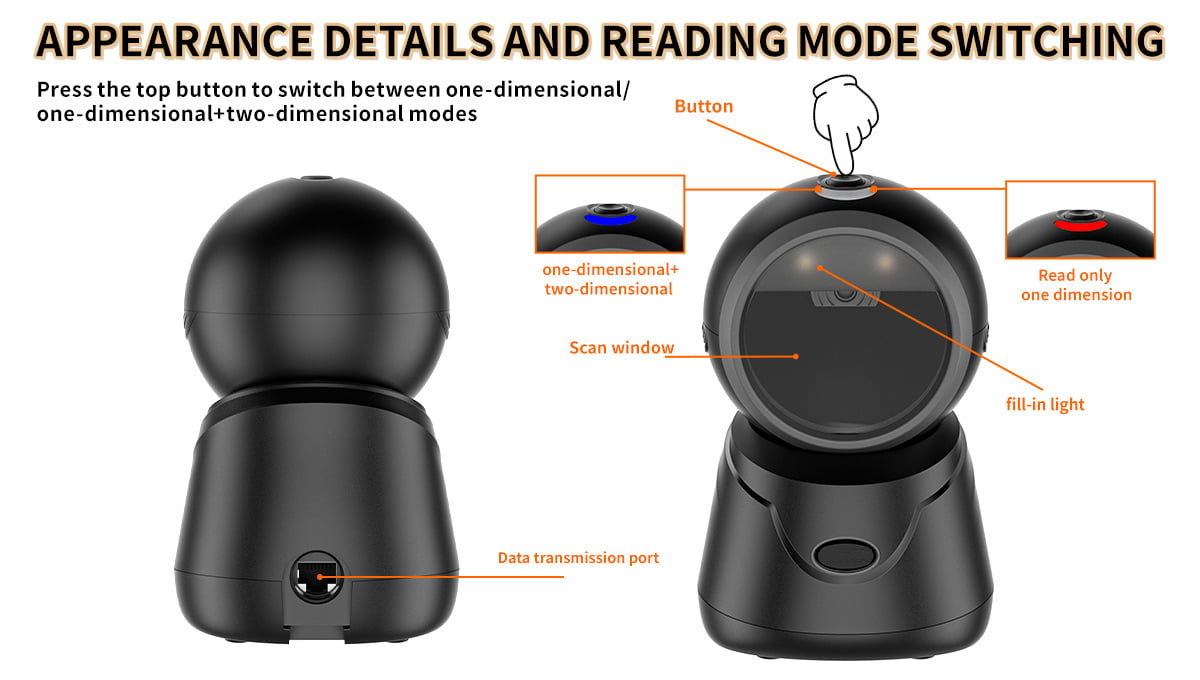
Global shutter — every pixel exposed at the same instant, no skewed frames
A rolling shutter reads the sensor row by row, so a code in motion is captured as a slanted image and needs the item to hold still for the length of the frame. Global exposure takes the whole array at once, which is why this unit holds its read rate on a lane where items are pushed past rather than placed. The engine is 640 × 480 at 30 fps with a 4 mil floor on Code 39 — enough for a 13 mil retail label and for the small codes on a curved bottle, up to the point where curvature distorts the bars beyond recovery.
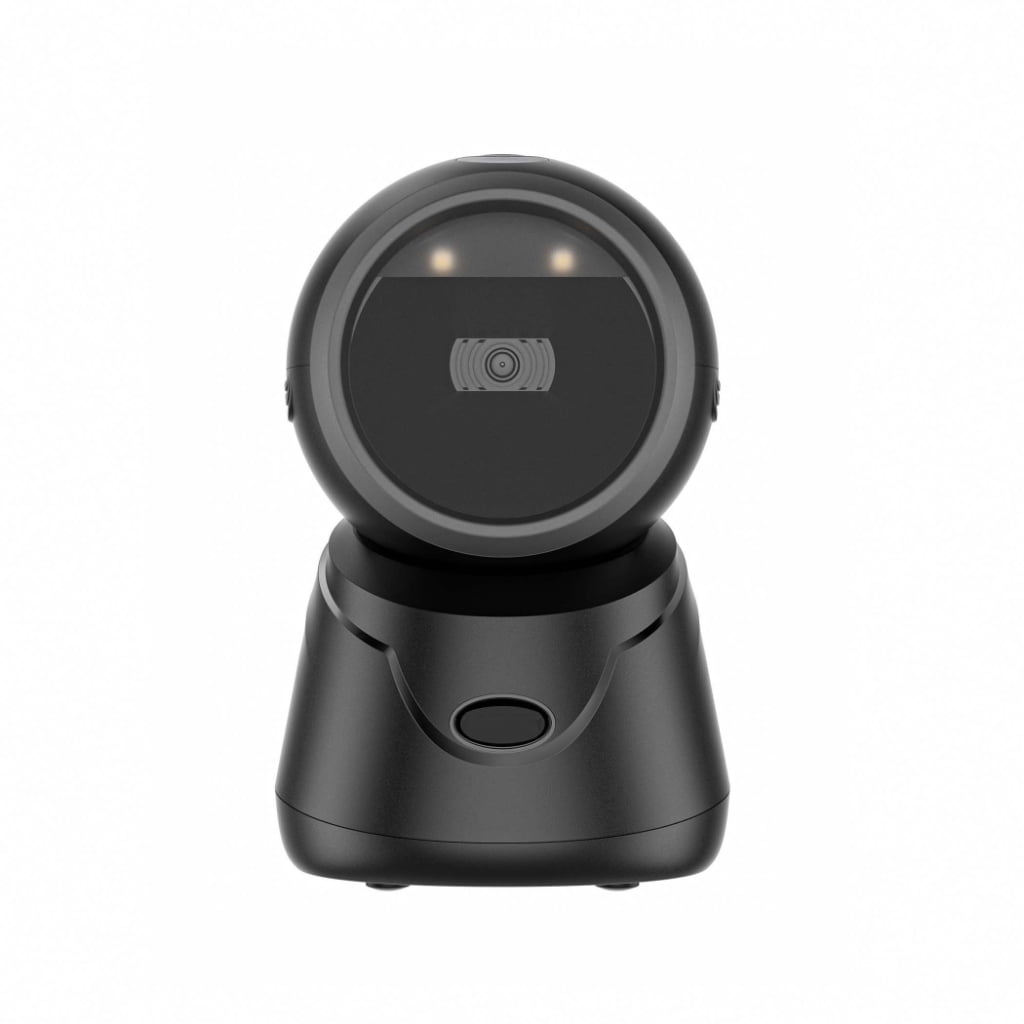
±65° front-to-rear tolerance with full 360° rotation
The window tolerates ±65° front to back and turns through a full circle, so it takes a code from above the counter or from a customer holding a phone at arm's length without being re-aimed. Tolerance matters most at the edge of the envelope: off-axis, the effective bar width compresses, and that is where a narrow-tolerance reader simply stops reading. In practice the operator stops squaring labels up at all, and that is the half-second per item the tolerance is buying.
Moulded 6–10° lean and warm 3500 K light that does not glare off receipt paper
The lean is moulded into the base rather than hinged, so the angle repeats across units and there is nothing to drift out of adjustment. A 6–10° tilt points the window at the customer's hand instead of the ceiling, so the code is in frame as the item comes over the counter. Illumination is warm white at 3500 K rather than blue-white LED: thermal receipt paper is already low contrast and slightly reflective, and the warmer light returns a cleaner edge without throwing glare back into the lens.
Technical Details
Full specifications, documentation, and customization options for engineering evaluation.
| Dimensions | 101 × 102 × 159 mm (L × W × H) |
|---|---|
| Material | ABS + PC |
| Barcode Scanner | 1D and 2D, 640 × 480 CMOS with global shutter at 30 fps, ≥ 4 mil minimum element (Code 39); QR Code, Data Matrix, PDF417, Aztec, MaxiCode, GS1 DataBar stacked |
| Power Supply | 5 VDC ±5%, 250 mA typical |
| Environment | Operating −20 °C to +60 °C; storage −40 °C to +70 °C; 5–95% RH non-condensing; IP52; 2 m drop; ESD ±8 kV direct discharge; 0–100,000 lux |
Frequently Asked Questions
Common inquiries from retailers, system integrators, and procurement teams.
What is the actual difference between a global and a rolling shutter here?
Speed. A rolling shutter needs the code to hold still for the length of the frame; a global shutter captures the whole sensor at once. On a slow lane you will not notice. On a lane where items are pushed past quickly, the global shutter is why the read rate holds up.
Can it read a code off a curved bottle?
Yes, up to the point where the curvature shortens the bars enough to distort them beyond recovery. A standard 500 ml bottle reads reliably. A small cylinder such as a pen refill pack does not.
Does the tilt angle adjust?
No. The 6–10° lean is moulded into the base. If a different angle is needed the base can be shimmed or the unit bracketed; the camera angle itself is fixed.
Will it work with a POS application that has no scanner support?
Yes, in USB HID mode. The application sees a keyboard typing digits, so anything that accepts manual entry accepts the scanner without a line of code.
Request a Quote for
SN-HC6052 2D Desktop Barcode Scanner
Our engineering team comes back with volume pricing, OEM options and lead time within one business day.
- Response within 24 hours
- NDA available for enterprise projects
- Free developer sample for qualified integrators
Synchronize Your Retail Ecosystem
Pair this terminal with dedicated peripherals for a fully integrated, single-vendor smart store deployment.