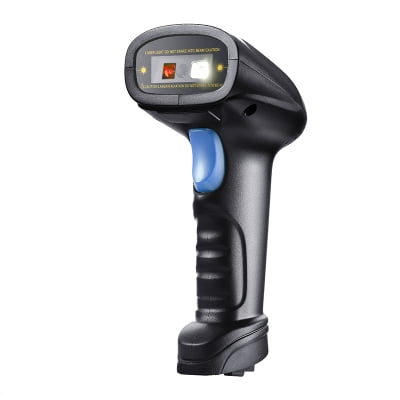
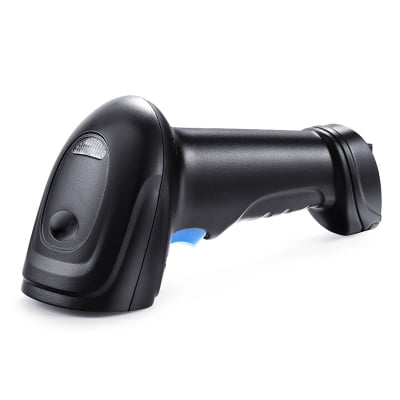
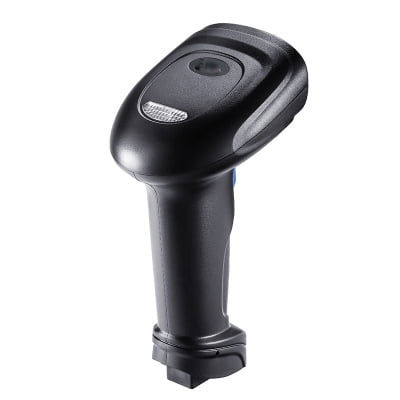
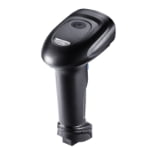
SN-HM330 Commercial 2D Barcode Scanner
Retail hardware specified for the work it actually does.
Print contrast of 35%, a 4 mil resolution floor and a 42 cm reach on a 20 mil Code 39 — three figures that decide whether a two-year-old faded shelf label still reads. 118 g, IP54, five drops from 2 m, and twenty keyboard layouts.
- MOQ 1 with 10–15 day lead time on stock models
- Spec sheets and SDK released before the order
- 12-month warranty, OEM branding available on volume orders
- SKU
- SQN-SN-HM330-COM
- Availability
- In Stock
- Lead Time
- 10-15 business days
- Warranty
- 12 months standard
Three numbers on the SN-HM330 are unusual for a general-purpose handheld, and they explain why this model is called the high-performance one rather than simply the newest. Print contrast of 35%. Minimum element of 4 mil. A 20 mil Code 39 readable at 42 cm. Most handhelds in this class quote 25%, 5 mil and somewhere around 20 cm.
Taken together those three figures describe a single real situation: a label that has been on a shelf or a carton for two years, printed on a thermal printer that was running hot, and now read from a distance because the shelf is above eye level. A 25% contrast floor fails on that label. A 4 mil floor fails on the small reorder code printed inside it. A 20 cm reach fails at the top shelf. This reader is specified to survive all three.
It weighs 118 g net — lighter than the M930 and the M4 in the same range — and the body is 174 × 71.5 × 92 mm with a ribbed grip and a molded index-finger rest.
Core specifications
| Imager | CMOS, 640 × 480 pixels |
|---|---|
| Minimum resolution | Code 39 at 4 mil |
| Print contrast | 35% minimum |
| Motion tolerance | 2.0 m/s |
| Scan angle | Roll ±360°, pitch ±60°, skew ±70° |
| Scan modes | Manual (trigger) and auto scan |
| Indicators | Blue power LED with decode flash; start and good-read beeper |
Decode range
| Code 39, 5 mil | 20–90 mm |
|---|---|
| UPC, 13 mil | 30–260 mm |
| Code 39, 20 mil | 60–420 mm |
| QR Code, 20 mil | 10–200 mm |
The 42 cm figure on a 20 mil Code 39 is the reason this model ends up on warehouse racks and on the top shelf of a stockroom: it is not a long-range scanner, but it reaches past arm's length without the operator stepping back.
Symbologies
1D: EAN-8, EAN-13, EAN-13 2-digit add-on, EAN-13 5-digit add-on, ISSN, ISBN, UPC-A, UPC-E, Code 11, Code 32, Code 39, Code 39 full ASCII, Code 93, Code 128, Codabar, Industrial 2 of 5, Interleaved 2 of 5, Matrix 2 of 5, ISBT-128, GS1-128, GS1 DataBar (RSS-14), GS1 DataBar Limited, GS1 DataBar Expanded.
2D: PDF417, MicroPDF417, Micro QR, Data Matrix, QR Code, Aztec.
ISBT-128 is worth calling out. It is the blood-banking standard, and a reader that decodes it is being sold into transfusion services, not just retail. If the account is a hospital blood bank, this single line is the difference between shortlisting and disqualification.
Power: manual mode costs a third of auto mode
| USB, manual scan | 0.046 A standby · 0.079 A operating · 0.156 A maximum |
|---|---|
| USB, auto scan | 0.132 A standby · 0.134 A operating · 0.197 A maximum |
| Serial, manual scan | 0.034 A standby · 0.068 A operating · 0.145 A maximum |
| Serial, auto scan | 0.121 A standby · 0.122 A operating · 0.200 A maximum |
This table is the least glamorous thing on the page and the most useful for anyone installing on a tablet or a battery-backed terminal. In auto-scan mode the reader illuminates continuously, so standby jumps from 46 mA to 132 mA — nearly three times the draw while it is doing nothing. If the deployment runs from a power bank, keep it in manual (trigger) mode and the runtime roughly triples.
Twenty keyboard layouts
English, French, Italian, German, Spanish, Finnish, Japanese, Russian, Arabic, Irish, Polish, Dutch, Czech, Portuguese (including Brazilian), Swedish, Turkish F, Turkish Q, Greek and Belgian-French, plus simplified Chinese output under Windows. Selection is by configuration barcode, so a mixed fleet can be normalized in the field.
Durability
| Drop resistance | Five drops from 2 m |
|---|---|
| Ingress protection | IP54 — dust protected, water splashes from any direction |
| Operating temperature | −20 °C to +55 °C |
| Storage temperature | −20 °C to +60 °C |
| Humidity | 5–95%, non-condensing |
| Ambient light | 0–70,000 lux |
IP54 rather than IP52 is the difference between a splash and a drip: it survives a knocked-over drink on the counter, not just condensation. The drop figure is stated as five drops, which is a repeated-drop test rather than a single-event one.
Physical and interface
| Dimensions | 174 × 71.5 × 92 mm |
|---|---|
| Net weight | 118 g |
| Gross weight | 292 g including packaging |
| Cable | 180 cm ±3 cm |
| Interface | USB HID (driver-free), USB virtual COM, or RS232 (driver-free) |
| Input voltage | 5 V |
USB HID and RS232 both work without a driver; only the USB virtual COM mode needs one, and on Windows 10 and 11 that is the in-box CDC driver. Windows XP, 7, 8, 10, Linux, Android and MacOS hosts are all supported.
Where it fits
- Retail point of sale. Faded shelf and carton labels are the norm, not the exception; 35% contrast is there for them.
- Inventory and stock counts. The 42 cm reach on a 20 mil code keeps the reader off the ladder.
- Healthcare and hospital blood banks. ISBT-128 decoding on the same unit as the retail codes.
- Libraries. ISSN and ISBN alongside the borrower barcode, with a 4 mil floor for spine labels.
Two limitations stated up front
No secondary development. The manufacturer does not expose an SDK for this model, so anything that needs custom firmware behavior — a bespoke protocol, an on-reader transformation beyond prefix and suffix — has to be handled on the host. Prefix and suffix editing is supported; anything further is not.
The invoice function is China-market only. The reader can emit the Chinese invoice (fapiao) tax fields under Windows, but this is not a general feature and should not be quoted outside that market.
Ordering
SKU SN-HM330. Interface fixed at order: USB HID, USB virtual COM or RS232. 180 cm cable included, MOQ 1, 10–15 day lead time on standard configuration, OEM branding from 50 units.
Product image
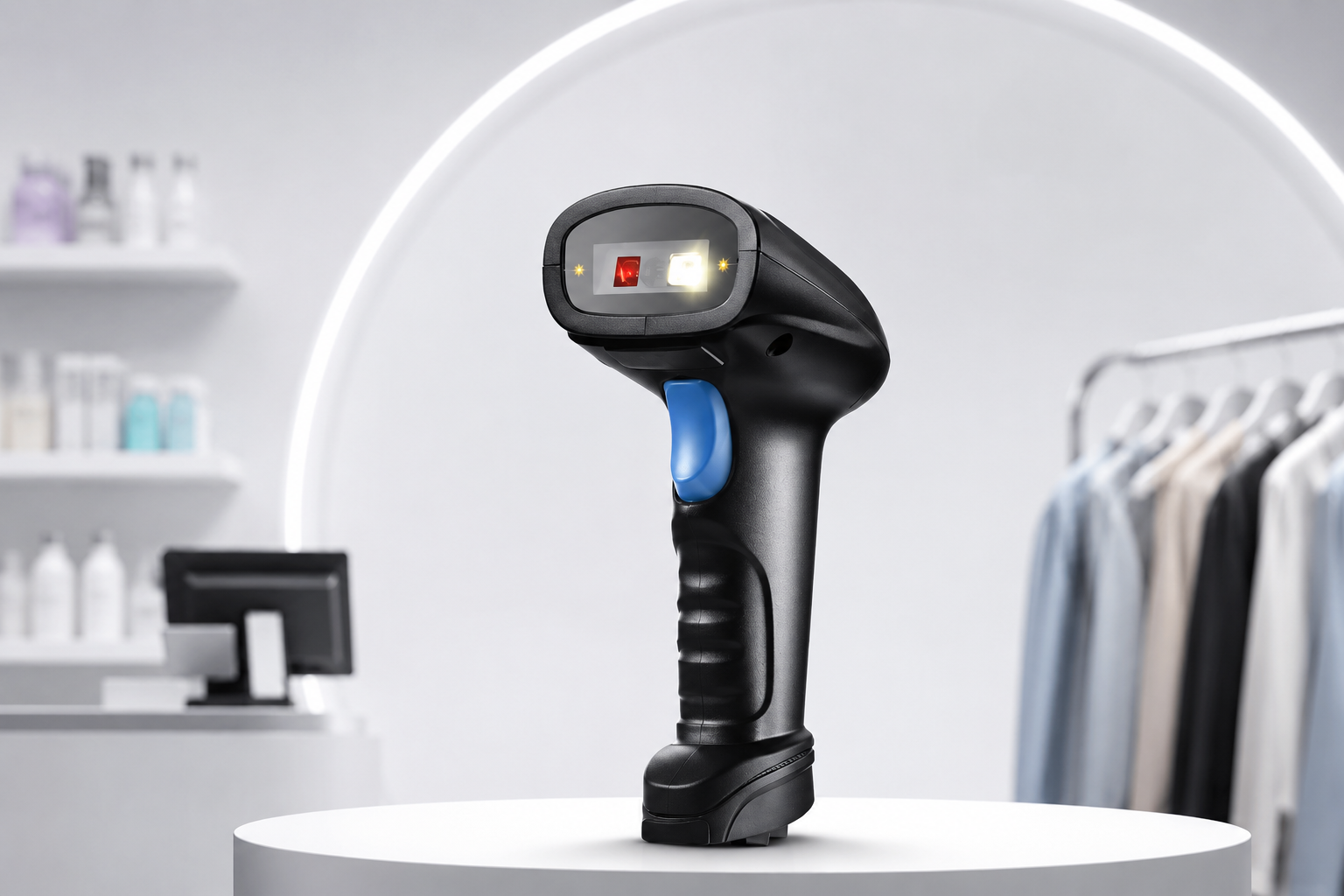
≥ 35% print contrast and a 4 mil floor — the faded-label model
Print contrast decides whether a label still scans in its second year: bars fade, spaces darken, and a reader rated at 25% starts failing on stock a 35% reader keeps taking. Test it on a label that has sat in a window for a year rather than on a fresh one. Minimum element is 4 mil on Code 39, ambient tolerance is 70,000 lux, and the engine is 640 × 480 CMOS with the ISBT-128 and GS1 DataBar families included.
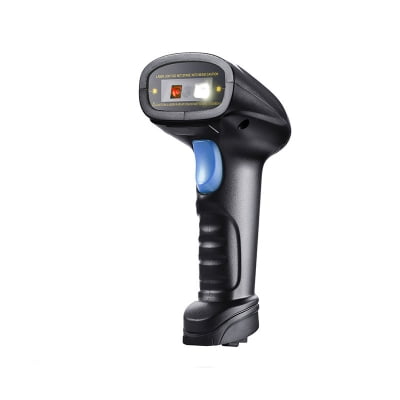
20 mil Code 39 readable at 42 cm without leaving the floor
A 20 mil Code 39 reads at 42 cm, far enough to take a carton label off a pallet or a shelf without lifting the reader to it — the case where a handheld earns its keep over a fixed window. Fine codes stay readable up close: 4 mil on Code 39. The long range applies to the larger element, so treat 42 cm and 4 mil as two specifications rather than one combined one.
118 g, IP54, five drops from 2 m, twenty keyboard layouts
The unit is 118 g net and sealed to IP54, with five drops from 2 m specified — the rating that matters once the reader leaves the desk for the floor, the stockroom or a delivery bay. Twenty keyboard layouts are held in firmware, so one SKU serves a region and a layout moves by configuration barcode rather than by part number. Draw is 46 mA standby and 79 mA operating in trigger mode on USB; leaving it in auto scan roughly triples the standby figure, which matters on a power bank and not on mains.
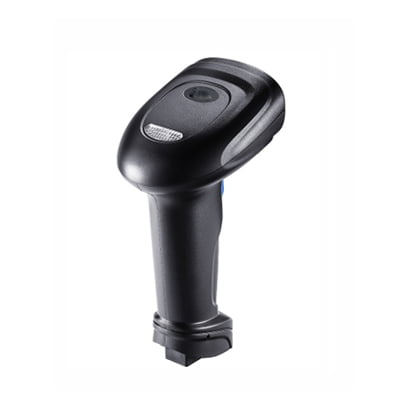
Technical Details
Full specifications, documentation, and customization options for engineering evaluation.
| Dimensions | 174 × 71.5 × 92 mm (L × W × H) |
|---|---|
| Barcode Scanner | 1D and 2D, 640 × 480 CMOS; Code 39 ≥ 4 mil; print contrast ≥ 35%; PDF417, MicroPDF417, Micro QR, Data Matrix, QR Code, Aztec; ISBT-128 and GS1 DataBar family supported |
| Power Supply | 5 V; USB manual scan 0.046 A standby / 0.079 A operating / 0.156 A max; USB auto scan 0.132 A standby / 0.134 A operating / 0.197 A max |
| Environment | Operating −20 °C to +55 °C; storage −20 °C to +60 °C; 5–95% RH non-condensing; IP54; five drops from 2 m; ambient light 0–70,000 lux |
Frequently Asked Questions
Common inquiries from retailers, system integrators, and procurement teams.
Why does auto-scan use so much more power than trigger mode?
Because the illuminator and decoder run continuously instead of waking on a press. Standby goes from 46 mA to 132 mA on USB. On mains power it is irrelevant; on a power bank it roughly triples the runtime to leave it in trigger mode.
Is 35% print contrast a real advantage or a datasheet number?
It is real and it is testable: take a label that has been sitting in sunlight for a year — the bars fade, the spaces darken, and a 25% reader starts failing. The 35% floor keeps those labels in service.
Can it read a code on a phone screen?
Yes. Screen-rendered codes are within the decode capacity, and the 70,000 lux ambient ceiling covers an indoor counter next to a window.
Does it support custom firmware?
No. Secondary development is not supported on this model. Prefix and suffix editing is available by configuration barcode; anything more complex has to be done by the host application.
How is this different from the HM930 and HM410?
HM930 is the faster one (2.5 m/s, 73 mA max, 29 1D symbologies, IP54). HM410 is the cheaper one but is IP42 with a 130 mm reach. If neither speed nor sealing is the deciding factor and faded labels are the real problem, this model is the answer — 35% contrast against 25% on both others.
Request a Quote for
SN-HM330 Commercial 2D Barcode Scanner
Our engineering team comes back with volume pricing, OEM options and lead time within one business day.
- Response within 24 hours
- NDA available for enterprise projects
- Free developer sample for qualified integrators
Synchronize Your Retail Ecosystem
Pair this terminal with dedicated peripherals for a fully integrated, single-vendor smart store deployment.