SN-HM410 Professional 2D Barcode Scanner
Retail hardware specified for the work it actually does.
IP42, three drops from 1.5 m, 25% print contrast and a 130 mm reach on a UPC label — the value model, stated plainly. Adds auto continuous scan and Han Xin decoding, and draws nothing measurable at standby on RS232 in trigger mode.
- MOQ 1 with 10–15 day lead time on stock models
- Spec sheets and SDK released before the order
- 12-month warranty, OEM branding available on volume orders
- SKU
- SQN-SN-HM410-PRO
- Availability
- In Stock
- Lead Time
- 10-15 business days
- Warranty
- 12 months standard
The SN-HM410 is the value model in this range, and the specification sheet is unusually honest about what that costs you. It reads the same 640 × 480 image and decodes the same code families as the higher models, but it reaches 13 cm on a UPC label where the HM330 reaches 26 cm, and it is rated IP42 with three drops from 1.5 m where the HM330 is IP54 with five drops from 2 m.
What you get in exchange: three scan modes instead of two, including auto continuous; a 122 g body; and the lowest unit cost of the three. For a counter reader that never leaves the desk, the durability gap is irrelevant and the saving is real.
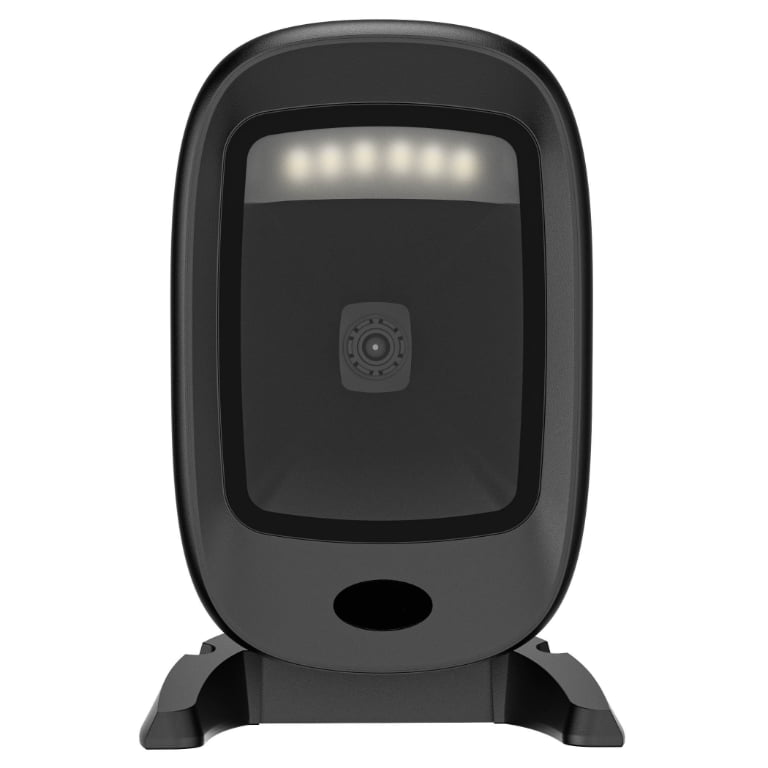
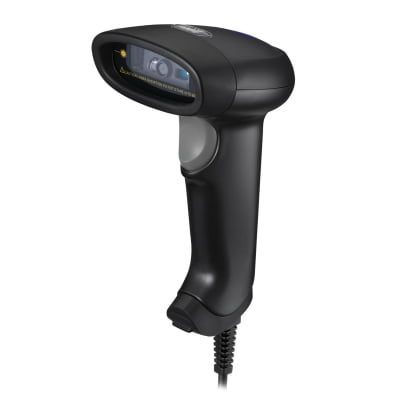
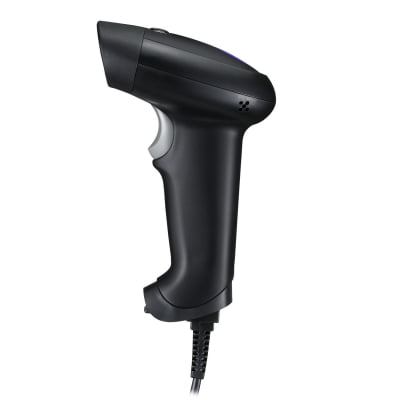
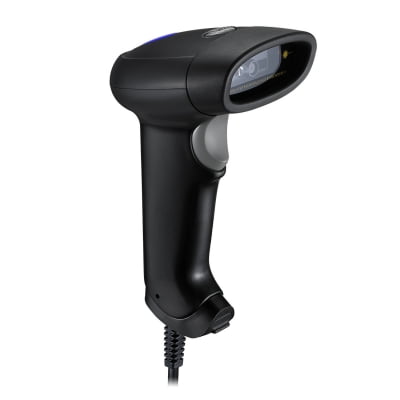
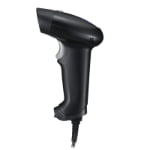
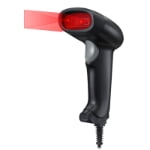
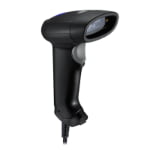
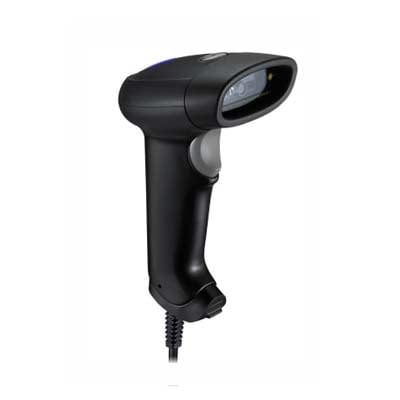
The body is 167 × 73.5 × 105.4 mm with a smooth housing, a wide gray trigger and a head cut at an angle so the window faces slightly downward when the unit is held at rest on a bench.
Core specifications
| Imager | CMOS, 640 × 480 pixels |
|---|---|
| Scan rate | 30 fps |
| Minimum resolution | Code 39 at 5 mil |
| Print contrast | 25% minimum |
| Motion tolerance | 2.0 m/s |
| Scan angle | Roll ±360°, pitch ±60°, skew ±70° |
| Scan modes | Manual, auto scan, auto continuous scan |
Decode range
| UPC, 13 mil | 40–130 mm |
|---|---|
| Code 39, 20 mil | 70–200 mm |
| QR Code, 20 mil | 30–140 mm |
Read the shortest column first. The 40 mm near limit on a UPC label is the closest of the three models, and it is the number that decides whether this reader works where you plan to put it: a counter reader at 100 mm is comfortably inside the band, a shelf reader at 400 mm is outside it entirely.
Symbologies
1D: EAN-8, EAN-13, EAN-13 2-digit add-on, EAN-13 5-digit add-on, ISSN, ISBN, UPC-A, UPC-E, Code 11, Code 39, Code 39 full ASCII, Code 93, Code 128, GS1-128, ISBT-128, Codabar, Industrial 2 of 5, Interleaved 2 of 5, Discrete 2 of 5, MSI, GS1 DataBar (RSS-14), GS1 DataBar Limited, GS1 DataBar Expanded.
2D: PDF417, MicroPDF417, Data Matrix, QR Code, Han Xin, Aztec.
Han Xin is the Chinese national 2D standard and appears on domestic logistics and industrial labels. It is present here at the value end of the range, which is not always the case.
Three scan modes, and when each one matters
- Manual — decode only while the trigger is held. Default for a handheld that is picked up and put down.
- Auto scan — the reader wakes when something enters the field and decodes once. Right for a desk where the operator has one hand busy.
- Auto continuous — keeps decoding while anything remains in view. This is the mode that makes the unit behave like a presentation scanner without a stand, and it is the one feature the HM330 does not offer.
Auto continuous should be used with a duplicate-read suppression setting, otherwise an item left under the window repeats into the POS. The suppression window is configurable by setup barcode.
Power
| USB, manual | 37 mA standby · 120 mA operating · 140 mA maximum |
|---|---|
| USB, auto | 92 mA standby · 119 mA operating · 140 mA maximum |
| Serial, manual | 0 mA standby · 113 mA operating · 135 mA maximum |
| Serial, auto | 90 mA standby · 113 mA operating · 136 mA maximum |
The zero in the serial-manual row is not a typo: on RS232 with the trigger unused, the reader draws nothing measurable at standby. If the installation is a fixed serial terminal on a metered supply, that is the configuration to pick.
Keyboard layouts
English (American and British), French, Italian, German, Norwegian, Spanish, Finnish, Japanese, Russian, Danish, Portuguese (including Brazilian), Swedish, Turkish F, Turkish Q and Belgian-French. Sixteen layouts, set by configuration barcode. Windows XP, 7, 8 and 10, Linux, Android and MacOS hosts are supported.
Durability
| Drop resistance | Three drops from 1.5 m |
|---|---|
| Ingress protection | IP42 — solid objects over 1 mm and dripping water |
| Operating temperature | −20 °C to +55 °C |
| Storage temperature | −20 °C to +60 °C |
| Humidity | 5–95%, non-condensing |
| Ambient light | 0–70,000 lux |
IP42 and 1.5 m is a counter-grade rating, not a floor-grade one. A drop from a checkout counter is inside it. Being knocked off a shelf or dropped on concrete during a stock count is not, and if that is the environment the HM330 is the correct purchase.
Physical and interface
| Dimensions | 167 × 73.5 × 105.4 mm |
|---|---|
| Net weight | 122 g |
| Gross weight | 296 g including packaging |
| Cable | 180 cm ±3 cm |
| Interface | USB-HID, USB-COM or RS232 |
| Input voltage | 5 V |
Where it fits
- Retail point of sale. A desk reader that never leaves the counter, at the lowest cost in the range.
- Healthcare and clinics. Close-in reads on boxes and wristbands; the 40 mm near limit is an advantage here.
- Hospitality. Bar and restaurant terminals where the reader is bolted down and gets splashed, not dropped.
- Warehouse desk work. Receiving paperwork and label printing at a fixed station, not on the rack.
How it compares with the HM330
| Print contrast | 25% here, 35% on the HM330 |
|---|---|
| Resolution floor | 5 mil here, 4 mil on the HM330 |
| Reach on UPC 13 mil | 130 mm here, 260 mm on the HM330 |
| Sealing and drop | IP42 / 1.5 m here, IP54 / 2 m on the HM330 |
| Scan modes | Three here (including auto continuous), two on the HM330 |
| Weight | 122 g here, 118 g on the HM330 |
If the reader stays on a desk in a dry indoor environment, none of the HM330's advantages get used and this model is the right buy. If it goes onto a rack, into a cold room, or anywhere near a floor, pay for the HM330.
Ordering
SKU SN-HM410. Interface fixed at order: USB-HID, USB-COM or RS232. 180 cm cable included, MOQ 1, 10–15 day lead time, OEM branding from 50 units.
Product image
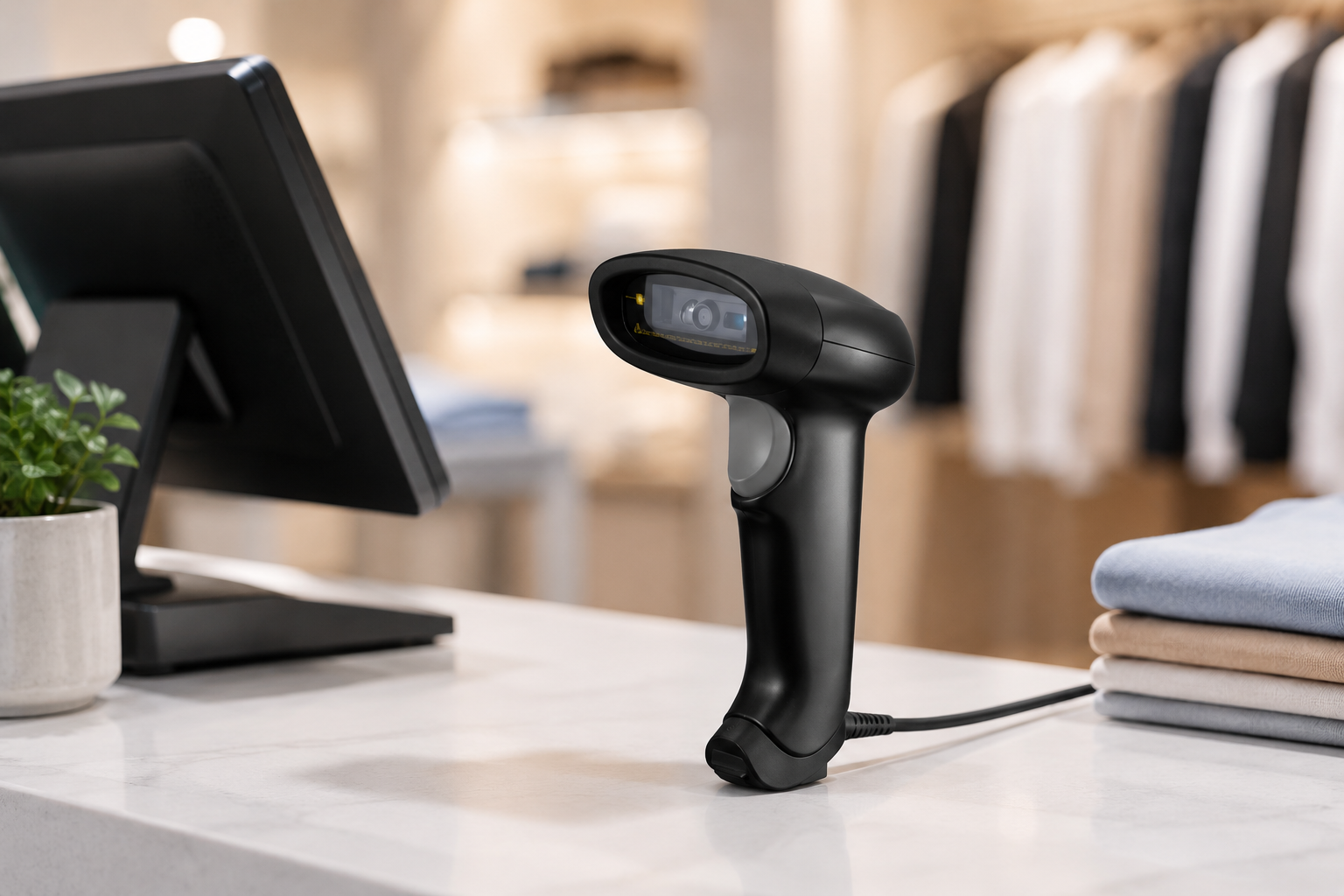
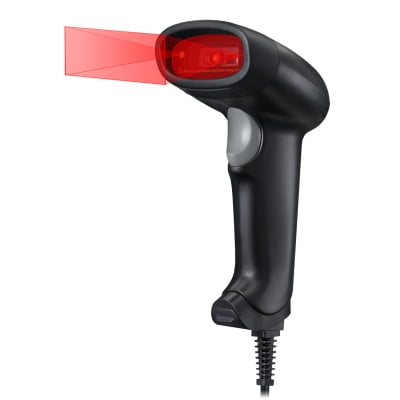
Auto continuous scan — keeps decoding while an item stays in view
In auto continuous scan the reader keeps decoding whenever a code is in the window, so a queue moves by sliding one product after another past it with no trigger press. Set a duplicate-read window or the same code repeats into the POS. Trigger mode is the setting for a fixed desk where items are placed rather than swept. The engine is 640 × 480 at 30 fps with a 5 mil floor and 25% print contrast.
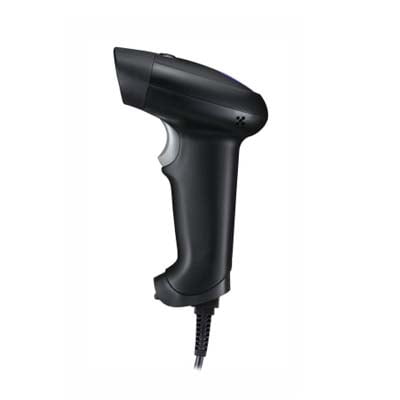
0 mA standby on RS232 in trigger mode
On RS232 in trigger mode the unit draws nothing at standby, which is the configuration for a terminal that leaves the reader idle for hours and for anything running from a battery. On USB the same state costs 37 mA standby and 120 mA operating, 140 mA at peak. The gap between trigger and auto scan is the illuminator running continuously: 92 mA standby in auto mode against 37 mA, which only matters if the supply is not mains.
Han Xin decoding and sixteen keyboard layouts at the value end
Han Xin, the Chinese 2D symbology, is decoded alongside PDF417, Data Matrix, QR and Aztec — the reason to specify this model for stock carrying domestic Chinese codes. Sixteen keyboard layouts sit in firmware, so a layout moves between markets by configuration barcode. Sealing is IP42 with three drops from 1.5 m, and the near limit is 40 mm: this is a desk reader, and the saving sits exactly in the ruggedness a fixed counter never uses.
Technical Details
Full specifications, documentation, and customization options for engineering evaluation.
| Dimensions | 167 × 73.5 × 105.4 mm (L × W × H) |
|---|---|
| Barcode Scanner | 1D and 2D, 640 × 480 CMOS at 30 fps; Code 39 ≥ 5 mil; print contrast ≥ 25%; PDF417, MicroPDF417, Data Matrix, QR Code, Han Xin, Aztec; ISBT-128 and GS1 DataBar family supported |
| Power Supply | 5 V; USB manual 37 mA standby / 120 mA operating / 140 mA max; USB auto 92 mA standby / 119 mA operating / 140 mA max; RS232 manual 0 mA standby |
| Environment | Operating −20 °C to +55 °C; storage −20 °C to +60 °C; 5–95% RH non-condensing; IP42; three drops from 1.5 m; ambient light 0–70,000 lux |
Frequently Asked Questions
Common inquiries from retailers, system integrators, and procurement teams.
Is it as rugged as the HM330?
No, and the datasheet says so plainly: IP42 with three drops from 1.5 m against IP54 with five drops from 2 m. That gap is the price of the lower unit cost, and it only matters if the reader leaves the counter.
What is auto continuous scan actually for?
A queue. In that mode the reader keeps decoding while an item stays in view, so the operator can slide one product after another past the window without pressing anything. Set a duplicate-read window or the same code will repeat.
Why is the near limit 40 mm?
The optics are focused for desk work rather than for distance. That is a deliberate trade: it buys the lower cost and it is why the reader feels immediate at 100 mm, where a long-focus unit would hunt.
Does it work with a POS application that has no scanner support?
Yes, in USB-HID mode. The application receives keystrokes and never needs to know a scanner exists.
When should I choose the HM330 instead?
When the reader leaves the desk. HM330 is IP54 with five drops from 2 m, reads 20 mil codes at 42 cm, and holds 35% print contrast; this model is IP42 with three drops from 1.5 m and a 130 mm reach. For a fixed counter in a dry room, none of that gets used and HM410 is the better buy.
Request a Quote for
SN-HM410 Professional 2D Barcode Scanner
Our engineering team comes back with volume pricing, OEM options and lead time within one business day.
- Response within 24 hours
- NDA available for enterprise projects
- Free developer sample for qualified integrators
Synchronize Your Retail Ecosystem
Pair this terminal with dedicated peripherals for a fully integrated, single-vendor smart store deployment.