Wiring a deposit to a trading company and wiring it to a factory look identical from the buyer's side. The proforma invoice has the same layout, the bank details are equally plausible, and the person answering your email is equally responsive. The difference shows up eight weeks later, when a batch arrives with a fault that nobody on the other end can trace, or when the answer to "why did the lead time move" is that the real factory had another customer that week.
These are the twelve questions that separate the two, in the order a buyer should ask them. For each one, the answer a plant gives, and the document or artefact that proves it. We answer all twelve about ourselves, because a page that only tells you what to ask is a page that has not been tested.
The short answer
Ask about ownership of the building, the inspection standard, burn-in, capacity against actual output, lead time by change type, minimum order, warranty per category, spare ratio, and certificates per model. A trading company can answer about three of those with specifics. A factory answers all nine without going away to check, because those numbers are how the plant is run.
The questions are below in four blocks. The last two blocks are the ones buyers skip, and they are where the money is: warranty and spares are the cost lines that arrive after the goods do, and they are the first things a trading company invents.
Block one: who you are actually buying from
1. Do you own the plant, or place orders in one?
The one question that determines the answer to every other question. If your supplier rents capacity, then the inspection standard, the burn-in duration and the lead time all belong to somebody else, and your supplier's promise is only as good as their relationship that month.
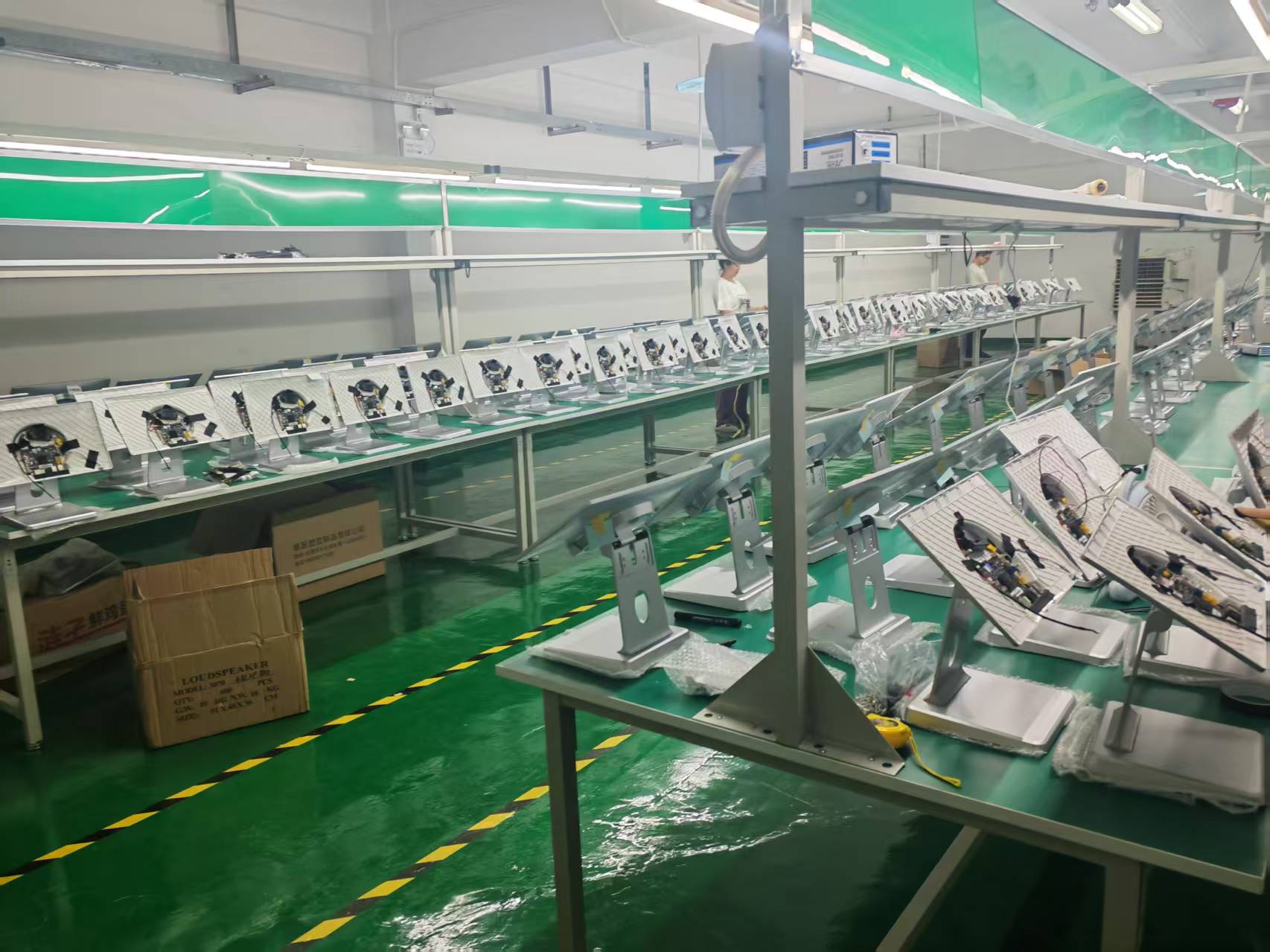
Our answer: we own a 5,400㎡ plant in Shiyan, Shenzhen, with a second line in Shajing, and have run it since 2019 under an ISO 9001:2015 system. Four assembly lines with 120 production operators build POS terminals, mini PCs, kiosks and electronic shelf labels there.
What to ask for: the business license with a registered address, and a factory audit report if you have one. The address on the license should match the address you are invited to visit. A supplier who cannot send a license with a factory address is a supplier without a factory.
2. Can I see the floor on a live call, unscripted?
Photos are curated and videos are edited. A live call where you choose the camera direction is much harder to stage, especially if you ask to see the area behind the line rather than the line itself.
Our answer: yes, on a scheduled call at a time you pick. Ask to see the burn-in racks, the inspection bench and the packing area in that order, because that is the sequence a unit travels and the sequence a staged tour gets wrong.
What to ask for: a call, not a file. And one unscripted question during it — "what is in those boxes on the left" — because the answer tells you whether the person showing you round has been on that floor before.
3. What happens in your building, and what happens somewhere else?
Almost no hardware supplier does everything in-house, and a supplier who claims to is telling you something about their honesty rather than their capability. The useful answer is the split.
Our answer: SMT placement happens at one qualified partner line. Assembly, burn-in, final test and packing all happen in our building. We do not claim an SMT line we do not have, because a buyer who discovers that later will discount everything else they have been told.
What to ask for: the split, in writing, with the name of the outsource partner for each process. Then decide whether the split matters for your product. For a POS terminal, SMT is a commodity process and a qualified partner line is normal. For a product where the PCB carries your IP, it is a different conversation.
Block two: how quality is actually controlled
4. What is your outgoing inspection standard, and who signs it?
"We check every unit" is not an inspection standard, it is a sentence. AQL is a standard, and the number after it decides how many defects you should expect in a thousand units.
Our answer: AQL II at Major 0.65 and Minor 1.0 on outgoing inspection, with 100% functional test on the key functions — the things that make the unit unusable rather than merely imperfect, such as power-on, display, printing, scanning and the cash drawer pulse.
What to ask for: the inspection record from a recent shipment, with the lot size, the sample size and the accept or reject decision. A factory runs this every day and can produce one in ten minutes. A trading company has to ask somebody.
5. Do you burn in every unit, and at what temperature?
An early-life failure is the most expensive kind, because it fails in your customer's store rather than in your warehouse. Burn-in moves that failure earlier, and the only two numbers that matter are the duration and whether it applies to every unit or a sample.
Our answer: every computing unit runs 48 continuous hours at 50°C before it is packed. The aging room holds 1,200 to 1,500 units at full load; around 800 carry production aging in a normal week, and the rest of the capacity holds first-article units, goods awaiting inspection and units held for return analysis.
What to ask for: the burn-in duration per unit, whether it is 100% or sampled, and the temperature. A 4-hour "aging" at room temperature is a soak test, not a burn-in, and it catches almost nothing.
6. What is your DOA window, and what happens on day 31?
The DOA policy is where a supplier's confidence becomes visible. A generous window costs the supplier money; a narrow one costs you the argument.
Our answer: 30 days. A unit that arrives dead within 30 days is replaced; after that it moves to the standard RMA process, which is repair rather than replacement.
What to ask for: the day count, who pays freight in each direction, and what the buyer must supply to open a claim — serial number, fault description, and whether a video is required. The freight question matters more than the day count: a 90-day window with freight at your cost is worse than a 30-day window with freight at theirs.
Block three: capacity, lead time and the difference between them
7. What is your monthly capacity, and what are you actually running?
These are two different numbers and suppliers routinely quote the first while shipping from the second. Capacity tells you whether your order fits. Actual output tells you whether there is room next month.
Our answer: capacity is around 20,000 units a month. Actual output runs about 10,000. The gap is deliberate: it is what lets a 50-unit private-label run and a seasonal rollout for a chain sit in the same quarter without one of them pushing the other out.
What to ask for: both numbers, and what share of capacity is currently committed to named customers. A plant running at 95% is a plant that will move your order when a larger one arrives.
8. What is the lead time for a configuration change, compared with new tooling?
A single lead-time number is always wrong, because changing the memory size and cutting a new housing are not the same job. Ask for the tiers, then check that the quote names which tier your order is in.
| Change type | What it covers | Lead time |
|---|---|---|
| Configuration change | CPU, RAM, storage, single or dual screen, MSR, NFC | 10 to 15 days |
| Appearance only | Logo, silkscreen, packaging artwork | 7 to 20 working days |
| New tooling | New mould, or a structural change to the housing | 15 to 50 working days |
What to ask for: the tier your order falls into, stated on the quotation. A supplier who quotes "20 to 25 days" for everything has either not understood your change or has not asked the factory.
9. What is the minimum order, and does the unit price hold at 50?
MOQ is where a distributor's business model becomes visible. A high minimum means the supplier needs volume before the order is worth their time, which is a legitimate position and also a signal about who they normally sell to.
Our answer: one unit for a standard configuration. OEM customization starts at 50 units, because that is where tooling and packaging setup stops being a cost the factory absorbs.
What to ask for: the MOQ per configuration rather than overall, and the price at 50, 200 and 500. A price that collapses between 50 and 200 tells you the 50-unit price was carrying setup cost; a price that barely moves tells you the margin was in the setup.
Block four: the costs that arrive after the goods do
10. What warranty applies to each category, in months, with what excluded?
One warranty number across a catalogue is a marketing number. Categories fail differently, and a supplier who quotes a single figure has either not thought about it or is quoting the shortest one and calling it universal.
| Category | Coverage |
|---|---|
| POS terminals, general range | 12 months |
| Selected terminal lines | 24 months |
| Barcode scanners | 24 months |
| Receipt and label printers | 12 months |
| KDS, industrial mini PC, payment kiosk | 24-month service coverage — 12 months warranty, then parts at cost with labor included through month 24 |
| Electronic shelf labels | 3 years |
Note the phrasing on the fourth row from the bottom. "24-month service coverage" is not the same as a 24-month warranty, and any supplier who writes "2-year warranty" and then charges for the parts in year two is describing coverage with a nicer word. Ask which one it is, and ask what the buyer pays in month 18.
What to ask for: the matrix per category, the exclusion list, and whether an extended contract is available and at what price. Ours runs to 3 or 5 years.
11. How many spare parts ship with the order, and who pays freight on a failure?
This is the question that separates a supplier who has shipped to a distributor from one who has shipped to a warehouse. A failed unit in another country costs more in freight and downtime than the part is worth, so the part should already be in the country.
Our answer: 2% of the ordered quantity, by unit count, shipped with the order rather than after a failure. It arrives in the same container, clears the same customs entry, and sits in your stockroom before anybody needs it.
What to ask for: the ratio, whether the spares ship with the order or on request, which parts are included, and whether the allowance is calculated on units or on value. A 2% allowance of units is a different thing from 2% of invoice value, and the difference is roughly a factor of five.
12. Which certificates do you actually hold, per model, per market?
Certification is the most commonly overstated claim in this industry, and the easiest to check, because a certificate has a number and a scope and can be verified with the issuing body.
Our answer: CE, FCC and RoHS are routine across the range. UKCA, RCM, NOM and IMDA apply to specific models only, and we will tell you which ones for the model you are ordering rather than implying the whole catalogue carries them. Where a market requires a certificate we do not hold for that model, we say so before the order rather than after.
What to ask for: the certificate number and the model list attached to each certificate, not a logo wall. A logo wall is a claim; a certificate with a scope is evidence.
How a weak supplier answers the same twelve questions
The value of asking is not the answer, it is the shape of the answer. Someone reading from a plant's actual numbers gives you figures with conditions attached. Someone improvising gives you round numbers with no conditions.
| Question | Answer that should worry you | What it costs you later |
|---|---|---|
| Do you own the plant? | "We have a long-term partnership with our factory" | No control over inspection, lead time or priority |
| Live floor call? | An edited video, or "our factory does not allow it" | You never verify anything else on this list |
| Inspection standard? | "100% inspection, zero defects" | No AQL means no sampling plan and no reject decision |
| Burn-in? | "Aging is done" with no duration | Early-life failures arrive in your customers' stores |
| DOA window? | Long window, silent on freight | The freight on one return can exceed the margin on ten units |
| Capacity? | A single large number, no current output | Your order moves when a bigger one lands |
| Lead time? | One number for every change type | The new-tooling order arrives five weeks late |
| Warranty? | "Two years" with no exclusions | Year two is chargeable and you find out at claim time |
| Spares? | "Available on request" | A failed unit waits for an international shipment |
| Certificates? | A logo wall, no numbers | A customs hold at the destination port |
What to put in writing before you wire the deposit
Every one of the twelve answers should end up in the proforma invoice or the supply agreement, because an answer in an email thread is a memory and a line in a contract is a claim you can enforce.
- The AQL and who inspects. The standard, the major and minor limits, and whether a third-party inspection is allowed at your cost before the balance is paid.
- Burn-in duration and coverage. Hours, temperature, and whether it applies to every unit or a sample.
- The DOA window and freight ownership. Day count, who pays each direction, and the evidence needed to open a claim.
- The warranty matrix. Per category, in months, with the exclusion list attached rather than implied.
- The spare-parts ratio, and that it ships with the order. Not "available on request".
- The lead-time tier your order falls into, and what specifically would move it.
- The certificate numbers and the model list each one covers.
- Tooling ownership, if you are paying for a mould. Whose property is it, and what happens to it if you move suppliers.
That last one is the item buyers forget and later regret. A mould is a five-figure asset that sits in somebody else's building, and the question of who owns it only becomes urgent at the moment you want to leave. None of it can be agreed until the enquiry is answerable, and the eight lines an RFQ has to fix are listed separately.
The wider supplier comparison — how to weigh a factory against a distributor against a brand — is covered in how to evaluate POS hardware manufacturers. If you have already shortlisted a plant and want to walk it properly, the 24-point factory audit checklist is the on-site version of this page.
Once those twelve items are agreed they become the order itself, and the terms we quote against — MOQ by tier, lead times, sample charges and the spare-parts commitment — are written out on our ordering terms page.
The same questions about us
The twelve answers above describe our own plant, and the pages that back them up are the ones a buyer should read next.
- The factory page carries the floor area, line count, headcount, burn-in capacity and inspection standard.
- OEM and ODM services covers what changes when the product is yours rather than ours, including tooling, packaging and certification scope.
- Becoming a distributor covers territory, pricing tiers and what we expect from a partner.
- The POS terminal range is where the twelve questions stop being about process and start being about a specific unit price.
- And if you are still assembling the specification itself, the EPOS component list sets out the five slots and what each one needs in interfaces and power.
If the product is a variation on an existing model rather than a new design, OEM versus ODM explains which of the two you are actually asking for, which decides whether you are paying for tooling at all.
Frequently asked questions
How do I tell a factory from a trading company?
Three checks, in increasing order of difficulty to fake. The business license should carry a factory address that matches the site you are invited to visit. A live video call should be possible at a time you choose, with you directing the camera. And the technical answers should contain conditions — a factory says which model, which configuration and which month, where a trading company gives a clean number.
What MOQ should I expect from a POS hardware factory?
For a standard configuration, one unit is reasonable and many factories will accept it because the product already exists. For OEM work — your logo, your packaging, your silkscreen — expect a real minimum, because setup is a cost somebody has to carry. Our OEM minimum is 50 units.
Is 48 hours of burn-in normal?
It is on the higher side for consumer electronics and normal for equipment that will run unattended in a store. The number that matters more is whether it applies to every unit. A sampled burn-in tells you about the batch; a 100% burn-in at 48 hours tells you about the unit in the box.
Should I ask for a third-party inspection?
Yes, on the first order and on any order where the specification has changed. Agree before the deposit that an inspection at your cost is allowed before the balance is paid, because that right is much harder to obtain once the goods are finished and waiting for a container.
What is a reasonable spare-parts allowance?
Two to five percent of the ordered quantity, shipped with the order. Below 2% the allowance covers only the most common failure; above 5% you are funding a warehouse. The number matters less than two conditions: that it is calculated on units rather than invoice value, and that it arrives with the goods rather than on request.
Does a longer warranty always mean a better supplier?
No, and the phrasing is where the trap is. Ask what the buyer pays in month 18. A 24-month warranty means the supplier covers parts and labor for 24 months; 24-month service coverage usually means 12 months of warranty followed by chargeable parts with labor waived. Both are legitimate; only one of them is what most buyers think they bought.