Selling POS Hardware into the UK: Plug, Voltage, Marking
The United Kingdom is the only market in this series where the plug itself contains a fuse, and that fuse is chosen by the cord rather than by the terminal. It is also the market where the marking question was settled by an amendment in 2024 and is still answered the old way on a great many supplier pages.
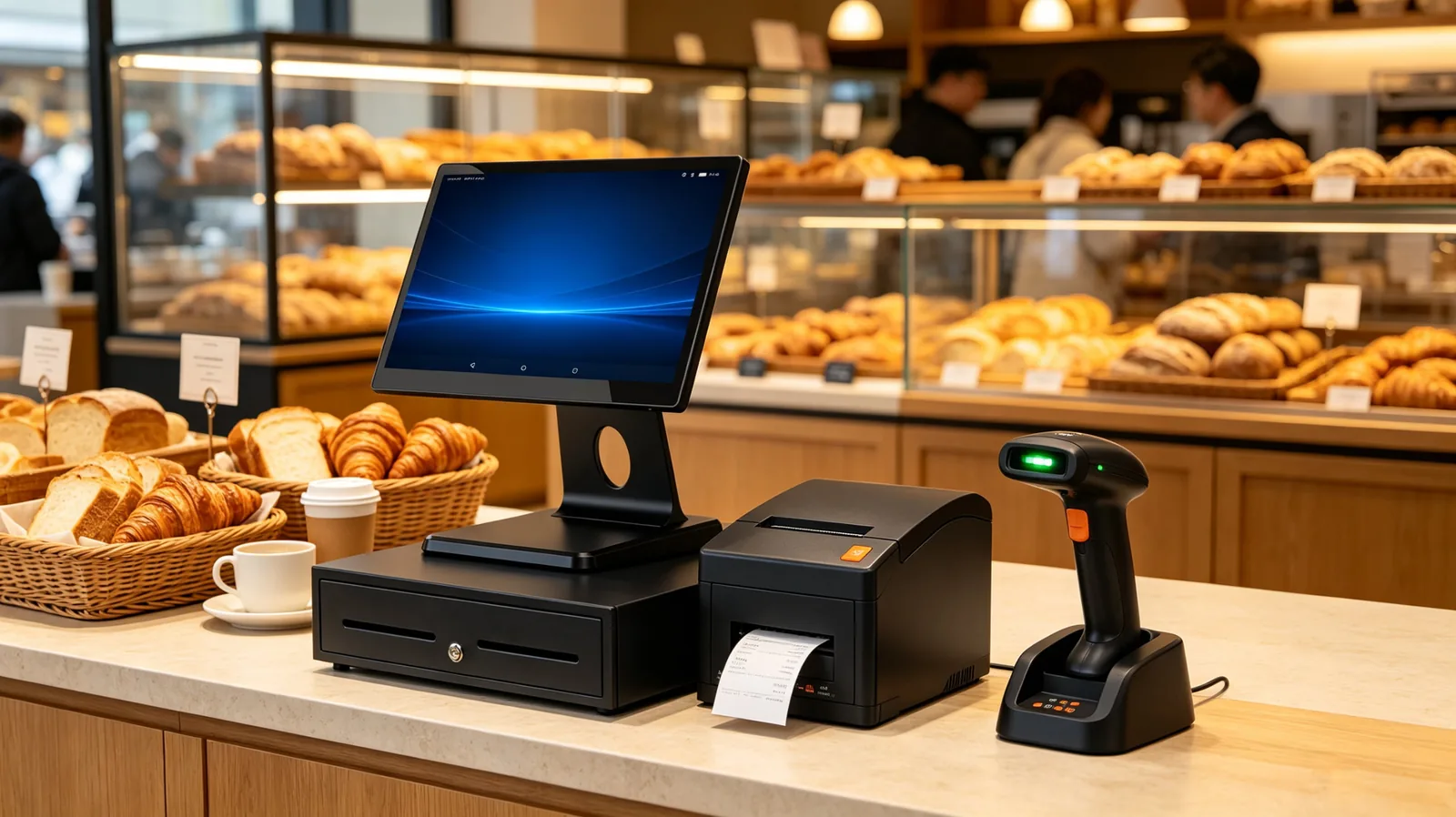
What a UK site actually looks like
A British counter is a 230 V site with 13 A socket outlets on a ring final circuit, a till position that occupies about a meter of counter, and a thermal printer within arm's reach of the operator. The vocabulary is EPOS rather than POS, which matters for search and for the words on a quotation but not for the hardware. The buyer is usually an EPOS reseller or a distributor holding stock, and the software house is a separate party again.
The load is trivial and the socket count is not. A 32 A ring final at 230 V is 7,360 W. A till position running a terminal and a printer at 68 W each is 136 W, so the ring could carry fifty-four of them. Nobody has fifty-four till positions. What a shopfitter runs out of is socket outlets and counter space, not current, and that is why a terminal with a built-in printer is worth more in the United Kingdom than it looks on a datasheet.
| What the site gives you | Number | What it means for the order |
|---|---|---|
| Nominal voltage | 230 V, 50 Hz | One adapter range covers the whole country |
| Permitted band at the socket | 216.2 V to 253 V | Plus 10 percent, minus 6 percent, per IEC 60038 |
| Socket outlet | 13 A, Type G, fused plug top | The fuse is part of the plug, not the circuit |
| Ring final circuit | 32 A at 230 V, so 7,360 W | Load is never the constraint; sockets are |
| Till position load | About 136 W for a terminal and a printer | 1.8 percent of one ring |
The plug: BS 1363, and a fuse that is set by the cord
BS 1363 is unusual among plug standards because it puts a cartridge fuse inside the plug top. The socket outlet is protected at 32 A by the circuit breaker, which is far too coarse to protect a 0.75 mm2 flexible cord, so the plug carries a BS 1362 fuse sized for the cord it is attached to. The fuse protects the cable. It does not protect the terminal, and it is not sized to the terminal's current draw.
This is where a POS shipment goes wrong quietly. Plugs arrive with a 13 A fuse because 13 A is the default that comes out of the box, and 13 A is the correct rating for a 1.25 mm2 or 1.5 mm2 cord feeding a 3 kW load. A till adapter is not that load.
| Fuse in the plug top | Cord it suits | Typical service | Where a POS falls |
|---|---|---|---|
| 3 A | 0.75 mm2 | Lighting, small adapters, IT equipment | The correct rating for a terminal or printer adapter |
| 5 A | 0.75 mm2 | Small heaters, older equipment | Rarely needed; acceptable but not the norm |
| 13 A | 1.25 mm2 to 1.5 mm2 | Kettles, heaters, up to about 3 kW | Oversized by more than an order of magnitude on a till |
The arithmetic is short. A 12 V 5 A adapter delivers 60 W. At roughly 88 percent efficiency it draws 68.2 W from the mains, which at 230 V is 0.30 A. A 3 A fuse sits at ten times the running current, which leaves room for inrush and still opens on a fault. A 13 A fuse sits at forty-four times the running current, which means a damaged cord can smolder inside the plug without the fuse noticing.
Two other details belong in the same conversation. The cord length is usually quoted as 1.5 m or 1.8 m, and on a counter that is the difference between an adapter on the floor and an adapter hanging in the air. And the plug top has to be molded rather than rewireable if the goods are going to a multiple without a technician on site, because a rewireable plug that is opened once is rarely closed to the same standard.
Voltage: 230 V nominal, 253 V at the top of the band
The United Kingdom works to a nominal 230 V with a permitted variation of plus ten percent to minus six percent, which is 216.2 V to 253 V at the point of supply. The 230 V figure is a harmonized number rather than a historical one: the country ran at 240 V for most of the twentieth century and the standard was re-based so that equipment could be built once for a European range.
The adapters we publish are 110 to 250 V, 50 or 60 Hz. That is 20 V above the 230 V nominal and 3 V below the top of the permitted band. The gap is worth naming rather than rounding away, because at a site that sits high on the band the nameplate and the socket are not describing the same number.
| Figure | Value | Source of the figure |
|---|---|---|
| Nominal | 230 V | Harmonized nominal, IEC 60038 |
| Permitted minimum | 216.2 V | Minus 6 percent |
| Permitted maximum | 253 V | Plus 10 percent |
| Published adapter input | 110 to 250 V | Our product datasheets |
| Gap at the top of the band | 3 V | 253 V minus 250 V, or 1.2 percent of 250 V |
In practice the band is a supply-quality envelope: a healthy site sits near 240 V and only reaches the top of the range during light load or when local generation is exporting. A retail park with rooftop solar on the units behind it is the case that actually shows up. If that is the site, put the measured voltage in the RFQ and ask for written coverage, because that is a question the datasheet can answer as a number and the marketing page cannot.
Marking: CE, UKCA, or both
This is the part of the United Kingdom that is most often written wrongly, including by suppliers who should know. UKCA was introduced for Great Britain after Brexit and was, for a period, the only mark that would be accepted after a deadline that was moved several times. That position changed.
The Product Safety and Metrology etc. (Amendment) Regulations 2024 extended the recognition of CE marking in Great Britain indefinitely, and from 1 October 2024 either CE or UKCA may be used for electrical equipment and for electromagnetic compatibility. Northern Ireland has always required CE and still does. UKCA may be affixed to a label or to an accompanying document rather than molded into the product until 31 December 2027.
| Territory | What is accepted | What this means for an order |
|---|---|---|
| Great Britain (England, Scotland, Wales) | CE, or UKCA, or both | Either mark clears the goods; no deadline is running any more |
| Northern Ireland | CE | UKCA alone is not enough here |
| Where the mark may sit | Product, or a label, or the accompanying document, until 31 December 2027 | A label is legally sufficient for now, which matters for stock already built |
Where the stock goes: the UK channel
United Kingdom demand reaches a factory through three doors. An EPOS reseller buys terminals, printers and drawers and installs them with a software product it owns. A distributor holds stock and sells to smaller resellers, which means mixed pallets and forward orders. A software house specifies the hardware its product supports and leaves the purchase to the reseller.
The practical consequence is that a United Kingdom order is rarely one configuration. It is a pallet with three terminal models, two printer models and one drawer, each with the buyer's logo on the boot screen and sometimes on the bezel. Configuration changes such as memory, storage, a second screen or a card reader run on a shorter cycle than changes to logo and packaging, and the two should not be quoted as one lead time because they are not one process.
Two things are worth settling before the first pallet. The first is whether the buyer's own company name and address go on the nameplate as the importer, because the electrical safety regulations put that information on the product or its packaging and it is artwork work rather than hardware work. The second is whether the goods are shipped to the reseller's warehouse or drop-shipped to individual sites, because drop-shipping turns one delivery into twenty and changes the packaging specification rather than the terminal.
Receipts: the VAT invoice and the 80 mm roll
A British till prints on 80 mm thermal paper at the counter and 58 mm on a handheld. The paper is the same product everywhere in Europe; what changes is the wording the software prints on it.
There is a distinction that catches exporters out. A customer receipt and a VAT invoice are not the same document. A VAT invoice has to show the supplier's name, address and VAT registration number, an invoice number, the date, a description of what was supplied, the rate of VAT and the amount of VAT. A till slip handed to a shopper is normally not a VAT invoice and does not need to be. Standard rate VAT is 20 percent, and a business customer who needs to reclaim it will ask for the invoice rather than the slip.
None of this is hardware, and all of it is the reason a printer has to be able to reproduce the characters the local software emits, including the pound sign and the VAT wording. A character set problem on a 58 mm handheld is a customer complaint; the same problem on a counter printer is a reprint.
What we can and cannot put in writing
| Claim | Our position | What we can send |
|---|---|---|
| CE declaration for electrical safety and EMC | We issue it; it is ours to sign | Declaration plus the test reports behind it |
| UKCA marking | Applied where the buyer's market entry calls for it | Test file and label artwork |
| That UKCA is compulsory in Great Britain | We will not write this | The 2024 amendment, for reference |
| RoHS | Routine on the models we ship | Test report |
| WEEE producer registration | Belongs to the United Kingdom importer or distributor | Nothing; it is not a factory obligation |
| Importer name and address on the nameplate | Printed to the buyer's artwork | Artwork proof before production |
The certifications page carries the position across all markets and is the right place to check the wording before it goes into a tender document: quality and certifications.
Which models to quote
The model list below is the short version for a United Kingdom counter. It is not a catalog; it is the five lines that cover most first orders.
| Model | What it is | Why it fits a UK counter | What to confirm on the PO |
|---|---|---|---|
| SN-P20 | All-in-one POS terminal | The volume counter unit; one adapter, one socket | 3 A fuse in the plug top, and the cord length |
| SN-C20 | 15.6 inch touch terminal, Windows | Where the back office runs serial peripherals from the till | Serial port count and the second-screen option |
| SN-W50 | 15.6 inch terminal with the printer built in | Saves a socket and about 300 cm2 of counter | VAT wording in the firmware, and the 80 mm roll |
| SN-POS8250 | 80 mm high-speed receipt printer | The standard counter printer when the terminal has no printer | 3 A fuse, and whether the drawer hangs off the printer |
| SN-CD410 | Heavy-duty cash drawer | Passive part driven by the RJ11 trigger | That the drawer accepts 12 V or 24 V, and the till insert layout |
For table service and queue busting, the handheld option is the SN-H30, which carries its own 58 mm printer. Printers are listed together under POS printers, and the terminal range starts at all-in-one POS terminals.
Five lines for a UK RFQ
- Plug type G to BS 1363, molded, with a 3 A BS 1362 fuse fitted, cord 1.8 m.
- Declaration of conformity to the electrical safety and EMC regulations, with test reports, and UKCA label artwork if the buyer's market entry requires it.
- Importer name and address printed on the nameplate to the attached artwork.
- Lead time separated into configuration changes and logo or packaging changes, quoted as two numbers.
- Service coverage stated as twelve months of warranty followed by repair at parts cost through month twenty-four, labor included.
The third and fifth lines are the ones that get left out. Importer details on a nameplate are artwork that has to be approved before the label is printed, and the service wording is the sentence a reseller will repeat to its own customer for two years. The ordering terms page carries the commercial side in full, and how to write a POS hardware RFQ covers the rest of the document.
One last comparison worth making before a United Kingdom order is signed. The country shares its 230 V nominal and its plus ten minus six percent band with Australia and New Zealand, and does not share the marking position, the plug, or the question of who signs the declaration. The two pages are worth reading together because the hardware answer is nearly the same and the paperwork answer is not.
All four countries, and the single table that shows which of them lets a manufacturer sign its own declaration, are set out on the four-market comparison.
Frequently asked questions
Do I need UKCA or CE for the United Kingdom?
Either. Since 1 October 2024 the United Kingdom recognizes CE marking indefinitely for electrical equipment and for electromagnetic compatibility, and UKCA remains valid as an alternative for Great Britain. Northern Ireland requires CE. The practical answer is to supply whichever the buyer's own market entry calls for and to keep both options available in the artwork.
What fuse should be fitted to the plug?
Three amps on a 0.75 square millimeter cord, which is the normal cord for a till adapter. The fuse protects the flexible cord rather than the terminal, so it is sized to the cable and not to the load. A POS terminal drawing 0.30 A behind a 13 A fuse has no useful protection at all, and 13 A is what arrives if nothing is specified.
My site measures 250 V. Is that a problem?
The permitted band in the United Kingdom runs from 216.2 V to 253 V, so 250 V is a normal reading rather than a fault. Our published adapter input is 110 to 250 V, which leaves 20 V of margin above the 230 V nominal and 3 V below the top of the band. If you need written coverage to 253 V, put the measured voltage in the RFQ so it can be answered as a number.
Can you print our company name on the nameplate as the importer?
Yes, and it is artwork rather than hardware. The electrical safety regulations put the importer's name and address on the product or its packaging, so we print to a proof that you approve before the label run. Send the exact legal name and address, not a trading name.
Do you supply a VAT-compliant receipt format?
The printer and the terminal supply the characters and the paper; the software supplies the layout and the wording. We can confirm that a model prints the pound sign, the 80 mm width and the character set your software uses, and we cannot draft the VAT wording because it depends on the retailer's registration and on the software.
What is the lead time for a United Kingdom order?
Configuration changes such as memory, storage, a second screen or a card reader are a different process from changes to logo and packaging, and they are quoted as two numbers rather than one. Ask for both in the RFQ, because a single figure will be the slower of the two and will make the configuration option look expensive.